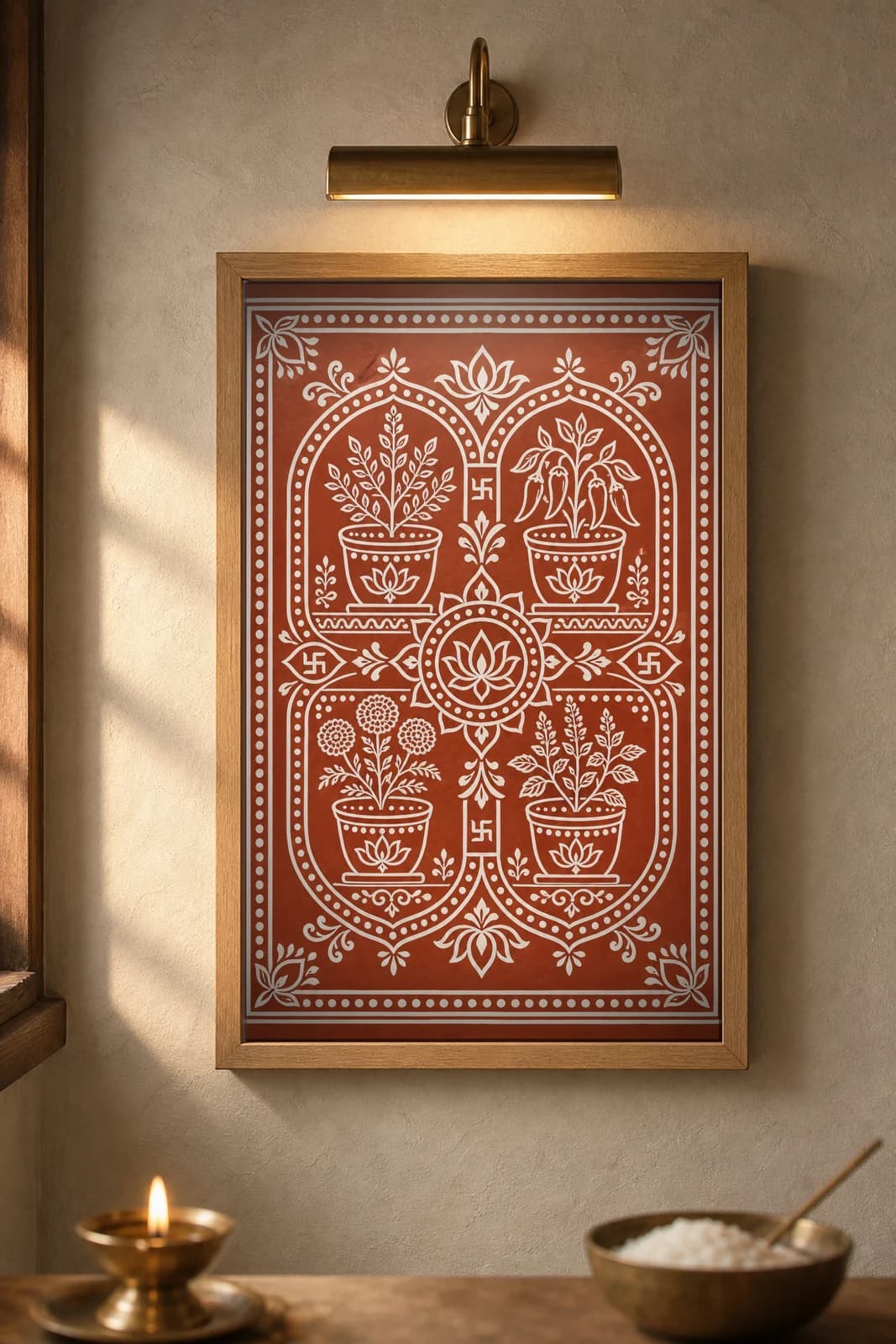
Fresh — 8 museum-grade prints that set the mood. Aipan is the ritual floor- and wall-art of the Kumaon region of Uttarakhand, drawn traditionally by Kumaoni women with white rice-paste (biswar) on a geru (red-ochre) earth ground. The chhat bageecha — the rooftop or courtyard kitchen garden of pots and saplings — is part of everyday hill-home life, with the lotus and swastika carrying the auspicious note. Munnar, high in the Idukki hills, is one of South India's great tea-growing regions, its slopes carpeted with clipped tea bushes since the colonial plantation era; the harvest is hand-plucking — 'two leaves and a bud' — carried in cane baskets slung from a forehead strap, work long done largely by women. The picture is built in the idiom of bhitti chitra, Kerala's temple-mural tradition, which uses the panchavarna five-colour system — red, yellow, green, black and white over an ochre ground — in flat opaque fields bounded by a bold lamp-black outline, with the school's signature elongated lotus-shaped eyes. The Baramasa ('twelve months') is a poetic cycle pairing each month with a mood of love; Sawan, the height of the monsoon, is conventionally the month of viraha — the longing of a woman for her absent beloved — shown with rain clouds, lightning, swollen rivers and dancing peacocks. This treatment follows the Kangra school of the Himachal foothills, which flourished in the late 18th and early 19th centuries under Raja Sansar Chand and is prized within the Rajput miniature umbrella for its lyrical naturalism and tender skies.