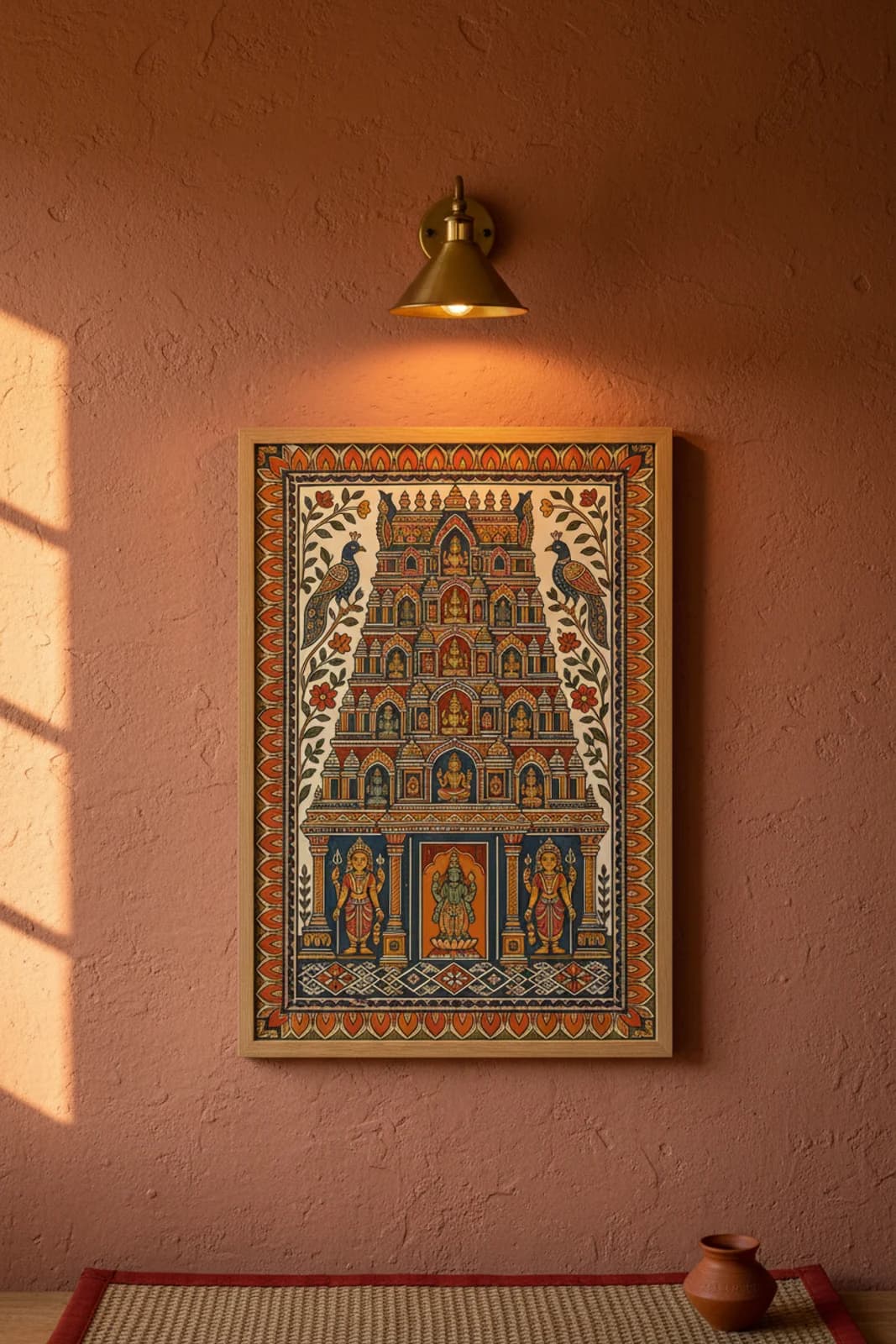
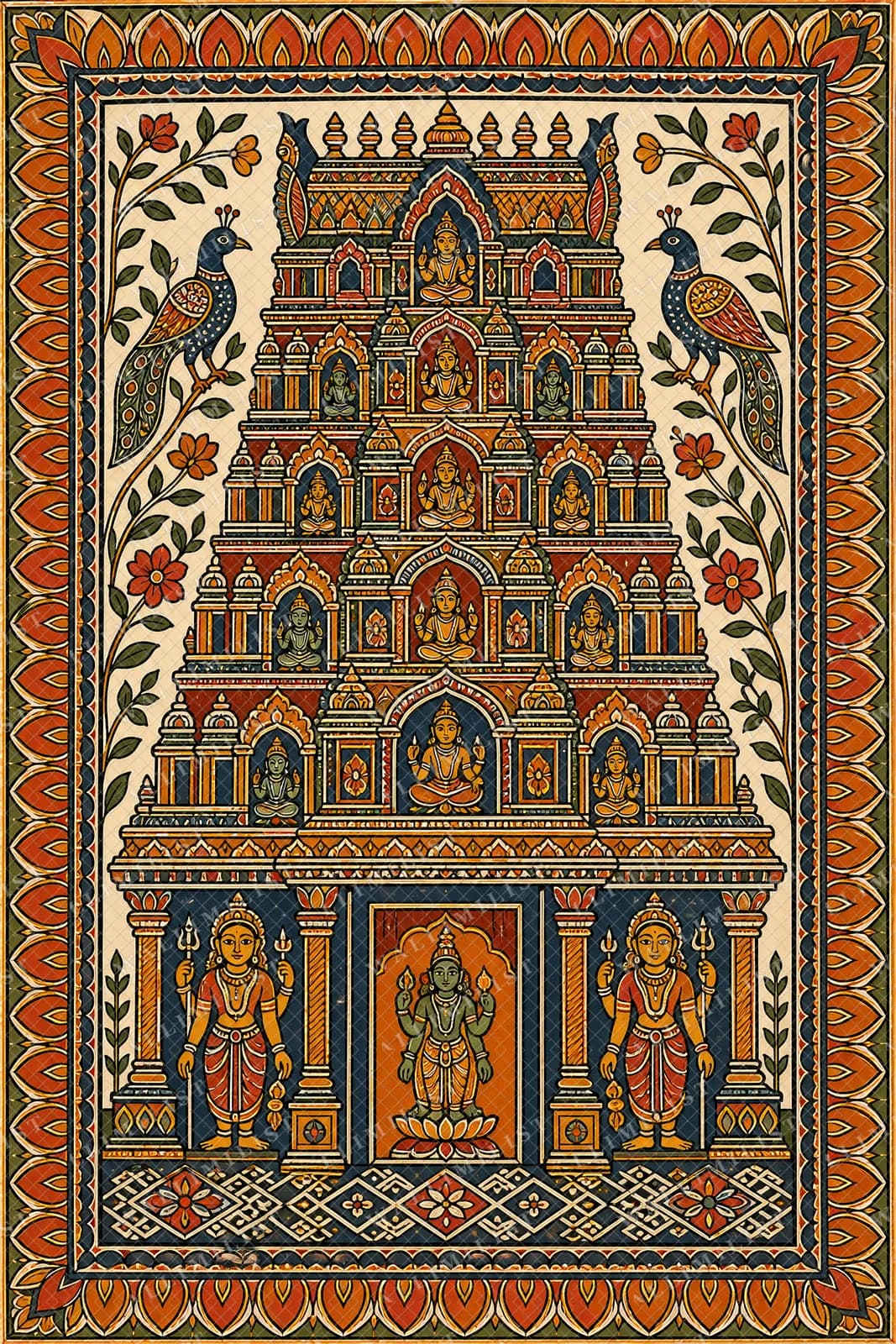
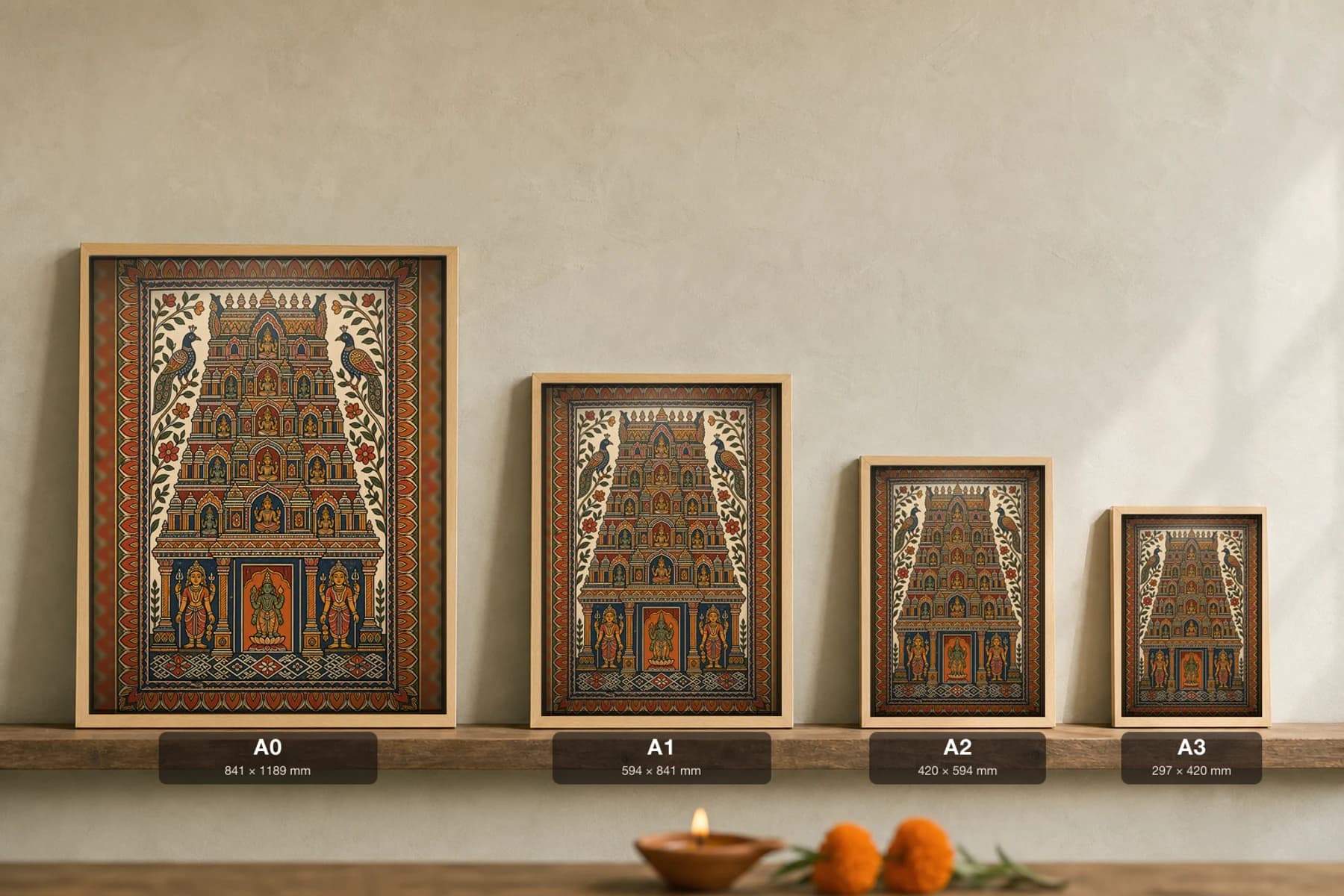
DESIGN BRIEF: A Tamil Nadu gopuram does not arrive in Mithila grammar by accident — Dravidian towers are vertical narrative stacks, and Bharni Madhubani solves vertical subjects through bilateral symmetry and tiered horizontal colour bands rather than perspective drawing. I chose vertical-bilateral layout so the tower sits on a single mirror axis: dvarapalas match left and right, peacock pairs face inward, and each gopuram tier reads as a readable festival band instead of foreshortened stone. The translation problem was sculptural depth — real Meenakshi or Kapaleeshwarar gopurams carry hundreds of stucco figures in deep relief. Here each tier compresses to a central deity niche flanked by mini-cells, the way Bharni wedding walls compress Ramayana episodes into stacked register panels. Dvarapalas keep trishula and four-armed posture because threshold guardians already exist in Mithila deity vocabulary; the green sanctum figure borrows Vishnu/Krishna colour convention without naming a specific temple bronze. Peacocks anchor the flanks — monsoon messengers in Mithila, natural companions to sacred architecture in South Indian decorative tradition — so the cream negative space never floats empty. The kolam ground panel at the base is the deliberate fusion anchor: Tamil floor geometry rendered in kachni line hatching inside an otherwise Bharni flat-fill tower, signalling that this is architecture translated across regions, not a Bihar village wall copied blindly.
 WALLIMILIST