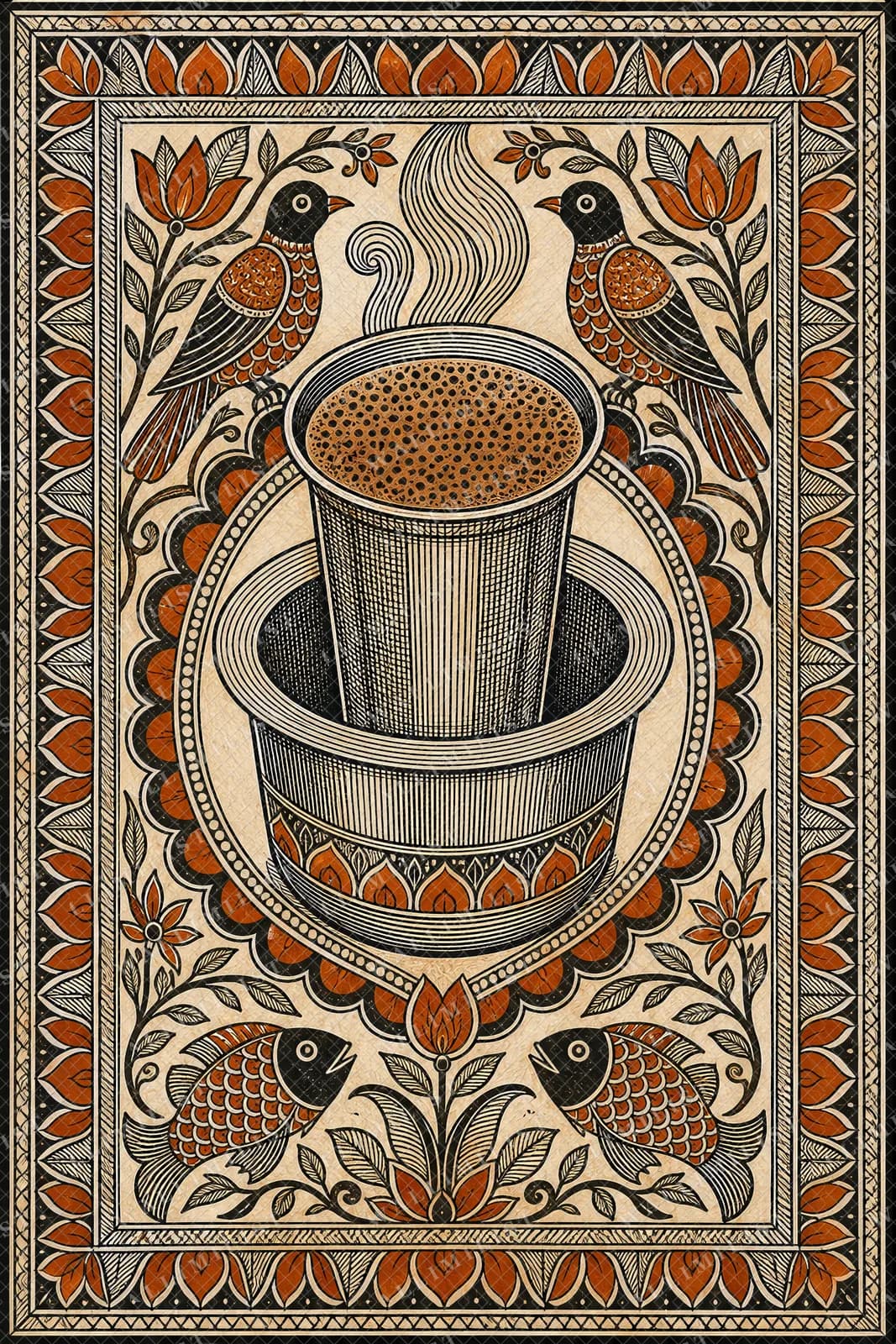
The brief was a north-south translation problem: how does a Chennai morning — steel dabara, smaller tumbler, metered decoction, froth head you blow across before the first sip — read inside Mithila line grammar without looking like a product illustration dropped on rice paper? Kachni was the right restraint. Parallel hatch carries the metal sheen and the patience of filter coffee itself; terracotta fill stays selective, reserved for lotus-petal scallops, fish bodies, and corner flowers so the vessels stay line-first, not poster-bold. Vertical-bilateral symmetry solved the layout: the dabara-tumbler stack cannot wander diagonally like a street auto, so the pair sits dead centre with birds above and fish below mirroring across the steam axis — classic Mithila abundance framing for a subject that is really a daily rite. What we simplified: brass versus steel, saucer spill, sugar lumps, filter apparatus. What we kept legible: the nested cup geometry, froth dot cluster, three steam ribbons, and that petal ring treating the pour like an offering plate. The outer kolam-adjacent triangle border holds the still life inside ritual floor geometry so the piece reads folk first, filter kaapi second.
 WALLIMILIST