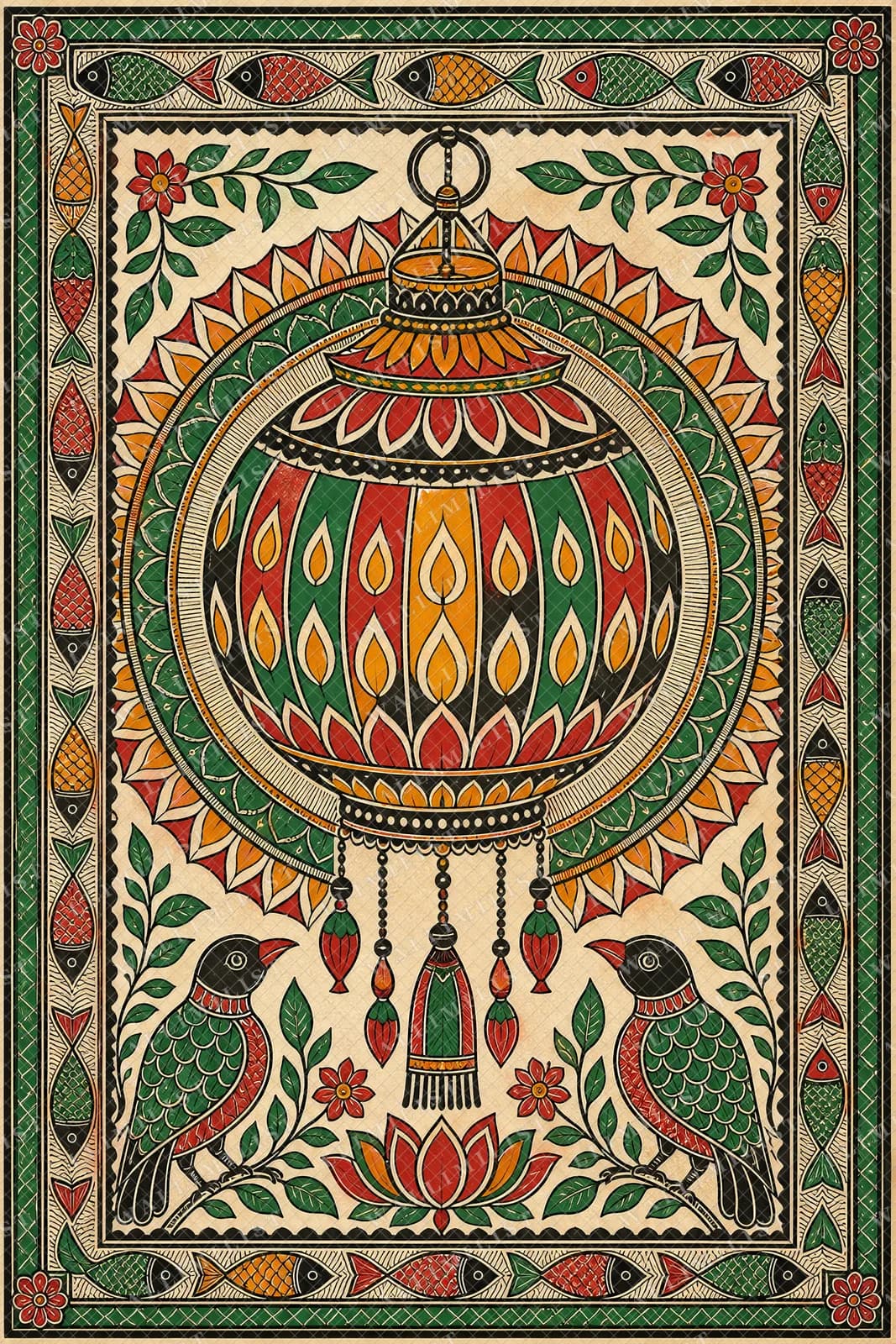
The brief was a translation problem, not a Diwali stock photo: how does a Northeast festival paper lantern — hinged panels, wax skin, a single flame flickering inside — read inside Mithila line without collapsing into craft-kit symmetry? Bharni gave the wedge answer. Flat green, red, and yellow vertical panels carry the kandil body at folk scale; double black contours replace bamboo ribs and wire clips with the same stroke weight used on wedding elephants and temple hangings. Radial-mandala symmetry was the layout fix — a hanging lantern cannot sit diagonal like a street auto, so the kandil becomes the mandala hub with concentric sun-halo rings (green inner disk, orange-yellow ray burst) radiating behind it while birds, lotus, and fish border hold the vertical frame. What we simplified: candle realism, panel text, wire geometry. What we kept legible: flame teardrops inside each wedge, tiered petal cap, beaded tassel strings, and the central green-red tassel with black fringe. The fish frieze is not filler — it re-anchors a paper-light festival object inside Mithila water-and-abundance symbolism so the piece stays folk first, Northeast second.
 WALLIMILIST