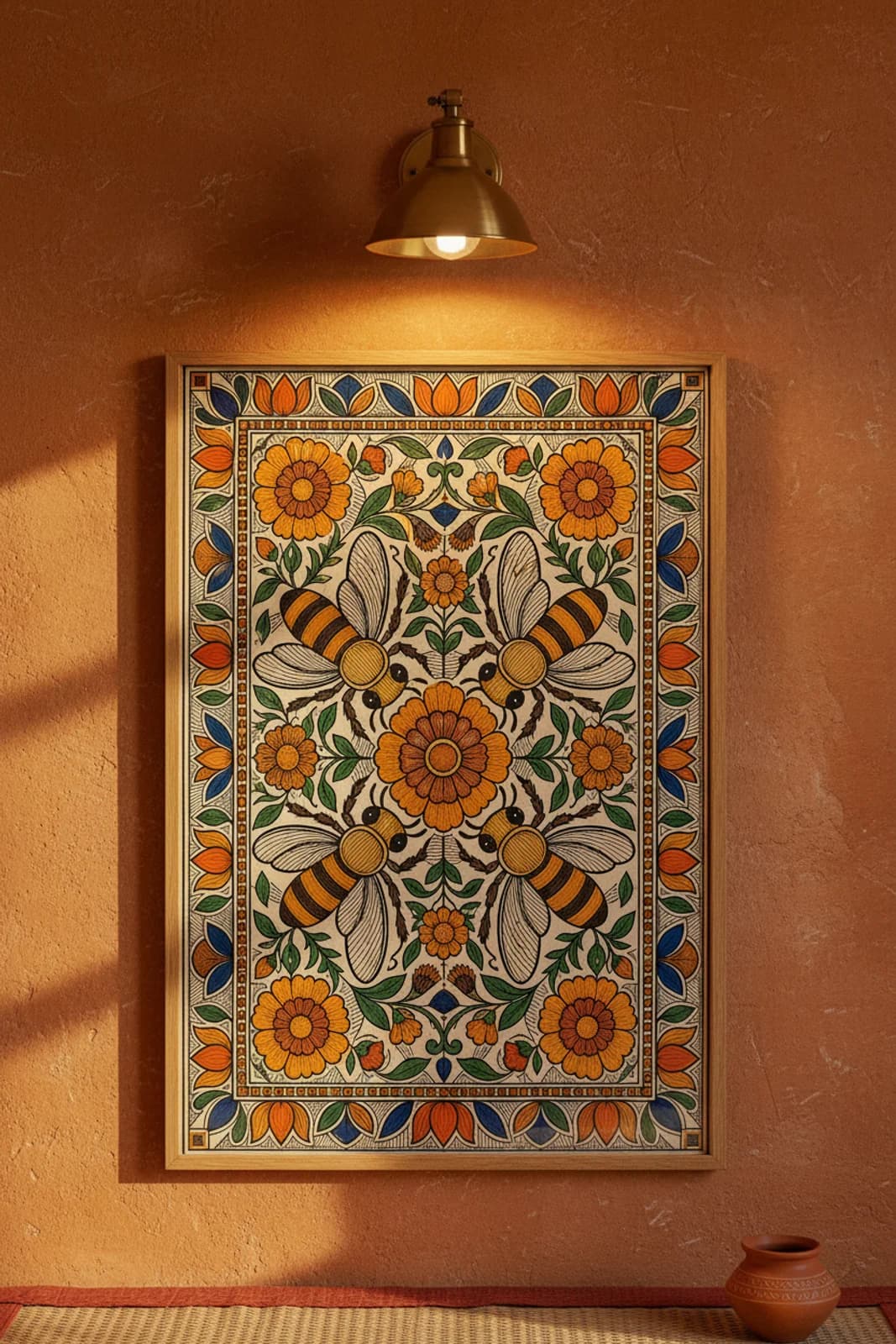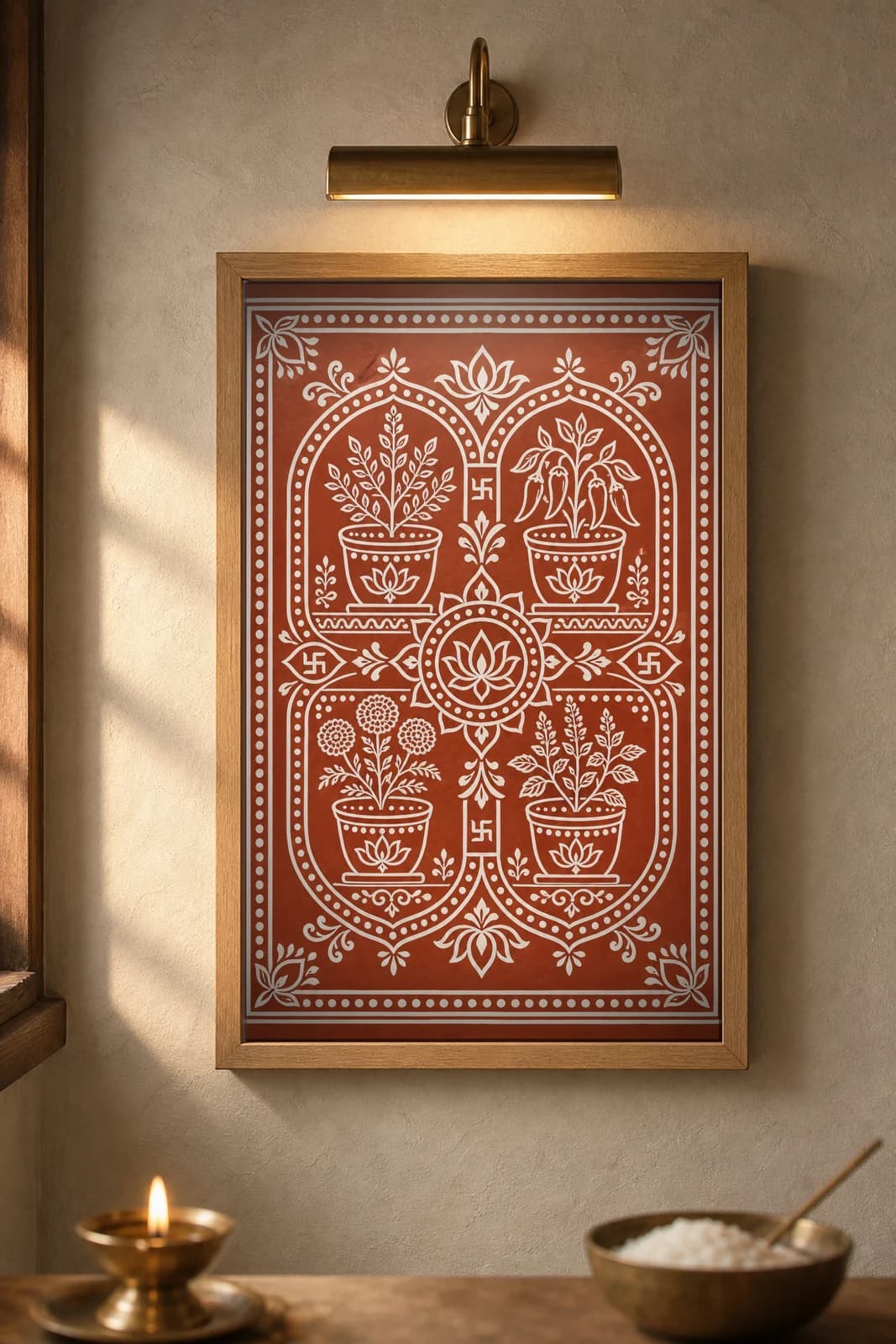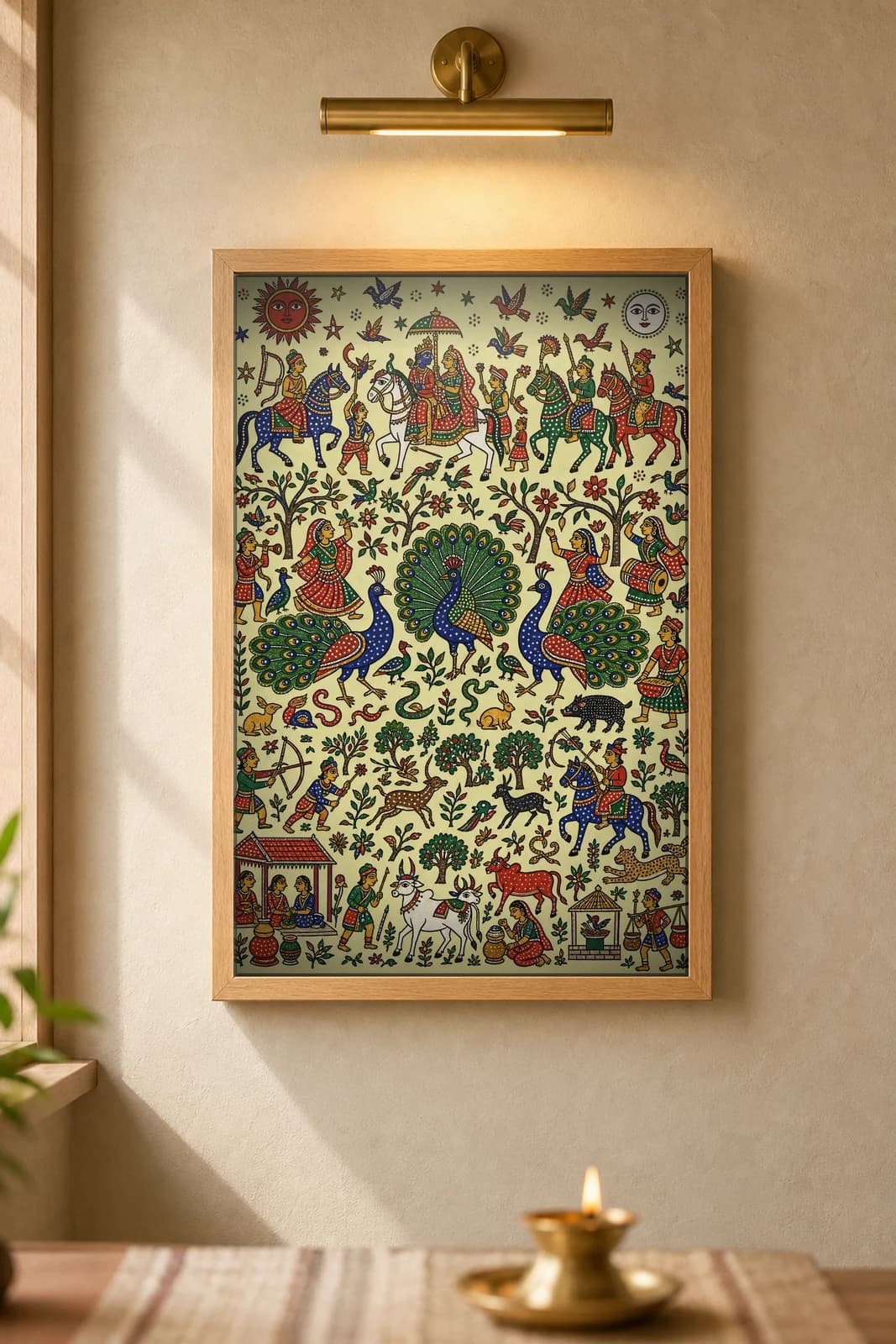
Sunroom — 10 museum-grade prints sized and toned for the room. Kachni — from the Hindi word for hatching or line work — is the Madhubani style associated with Kayastha women's compositions in the Mithila region, distinct from Brahmin Bharni flat-fill deity panels and Dusadh Godna tattoo dot-and-dash. Kachni artists build texture through parallel strokes on petals, wings, water, and border grounds, applying colour washes sparingly while lampblack outlines hold every form. Aipan is the ritual floor- and wall-art of the Kumaon region of Uttarakhand, drawn traditionally by Kumaoni women with white rice-paste (biswar) on a geru (red-ochre) earth ground. Makar Sankranti marks the sun's turn toward the north; across India it is greeted with rooftop kite-flying, and in the Kumaon hills the season carries its own Uttarayani and Ghughutia customs. Gond painting comes from the Gond Adivasi communities of central India, with its best-known school formed by the Pradhan Gond of Patangarh and the wider Dindori region of Madhya Pradesh. The contemporary form is largely the legacy of Jangarh Singh Shyam (1962–2001), whose line-and-in-fill manner — every form bounded by a bold outline, then filled with rows of dots, dashes, commas and scales — became known as Jangarh Kalam and was carried on by his family and students.