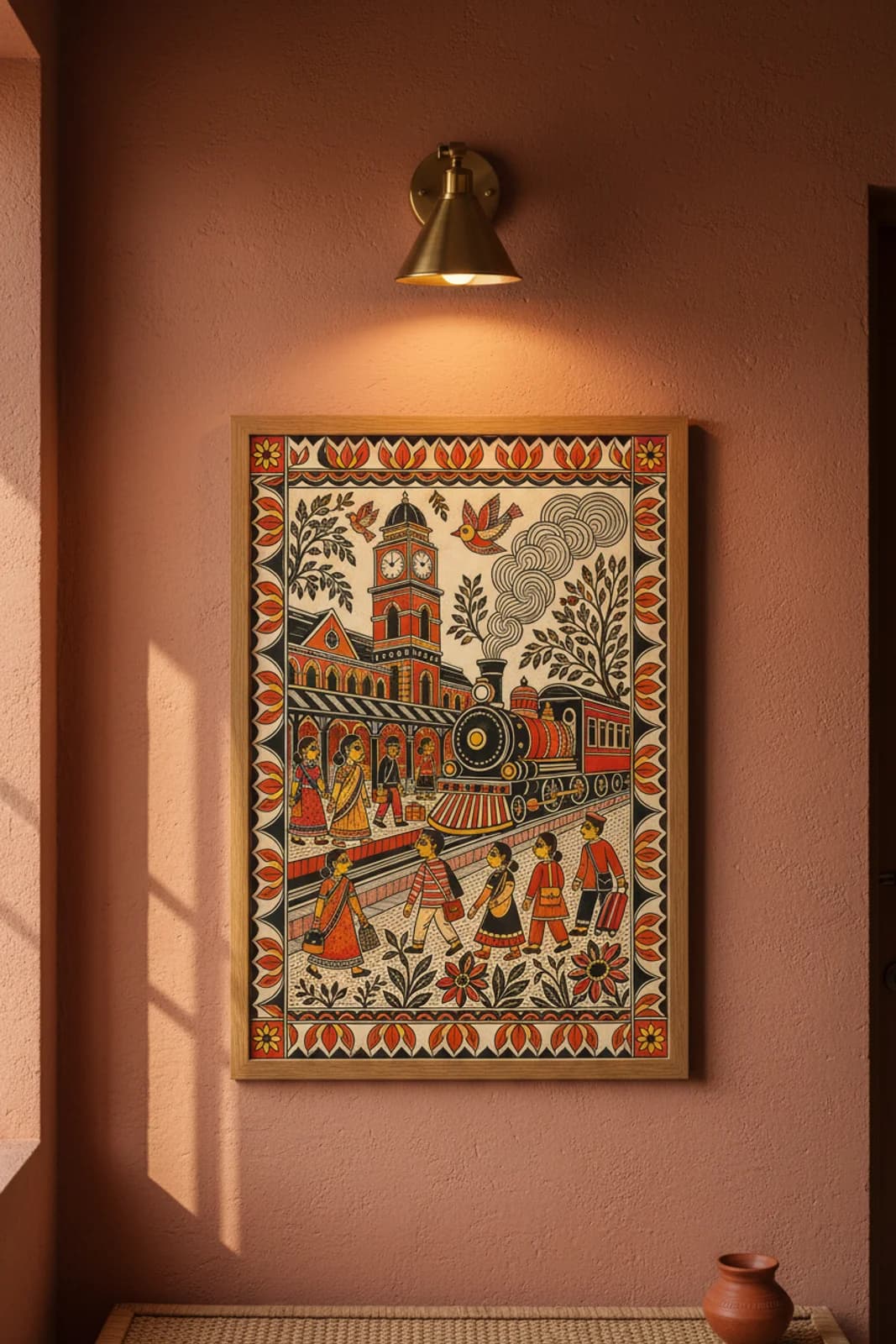
Cultural Bridge — 8 museum-grade prints that set the mood. Kachni — from the Hindi word for fine line — is the Madhubani tradition associated with Kayastha women painters who built form through dense parallel hatching, cross-hatch, and stippling inside bold double black outlines, distinct from Brahmin Bharni flat colour floods and Dusadh Godna tattoo dot grammar. On classical walls Kachni rendered bamboo, fish scales, peacock feathers, and manuscript page fields; on paper it became the line discipline of villages like Ranti and Jitwarpur after the 1960s famine-era transfer from mud-wall ritual to market craft. Aripana — from the Sanskrit alepan, to smear — is the Kayastha and Brahmin women's floor-diagram tradition within Mithila art, historically drawn with rice paste or cow-dung-clay on purified ground for weddings, Dev Uthani Ekadashi, Kamaldah lotus-pond rituals, and daily threshold blessing. Aripan is the Bihar cognate of Tamil Nadu kolam: both begin with a centre bindu and expand through confident geometric line work; kolam at Chennai thresholds often appears at dawn before household activity, while Mithila aripan accompanies vermillion papers and marriage processions. Kachni is the Kayastha women's line tradition within Madhubani painting — historically distinct from Brahmana Bharni flat-fill work. Where Bharni shouts in vermillion and lampblack solids, Kachni whispers through parallel hatching, stippling, and cross-hatching laid down with bamboo sticks, twigs, and fingers on cream or mud-plaster ground.