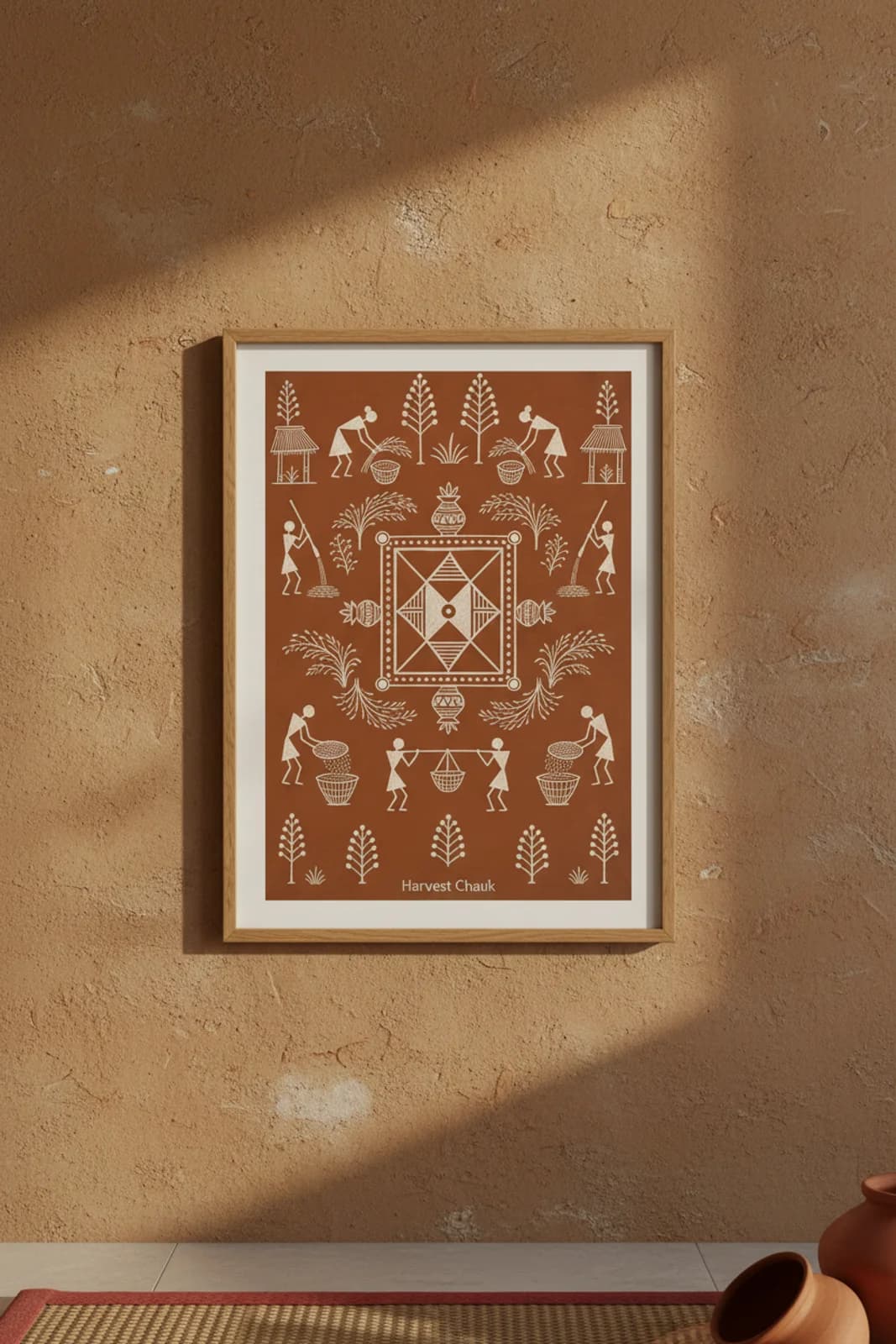
Kitchen Adjacent — 12 museum-grade prints sized and toned for the room. Warli painting belongs to the Warli Adivasi communities of the North Sahyadri range in Maharashtra — Talasari, Dahanu, Jawhar, Palghar, and Mokhada among the heartland districts where women traditionally painted rice-paste and gum pigment onto red ochre cow-dung or mud walls during weddings, harvests, and seasonal rituals. The geometric vocabulary — triangle torsos, circle heads, square chauk enclosures when ritual demands, horizontal bands for farming — encodes daily life rather than illusionistic depth. Agriculture dominates post-hunting Warli narrative — ploughing, planting, harvest carry, winnowing each use distinct symmetry (horizontal band, procession, scatter) not interchangeable spirals. Bullocks remain essential draft animals in Jawhar taluka hill agriculture. The village well remains a daily social node in Warli painting — water drawing, pot balancing, and neighbour conversation rendered in white rice paste on geru walls across Jawhar and Palghar talukas. Communal-ring layouts for seated gathering differ from tarpa harvest dance rings where standing linked dancers orbit a musician.