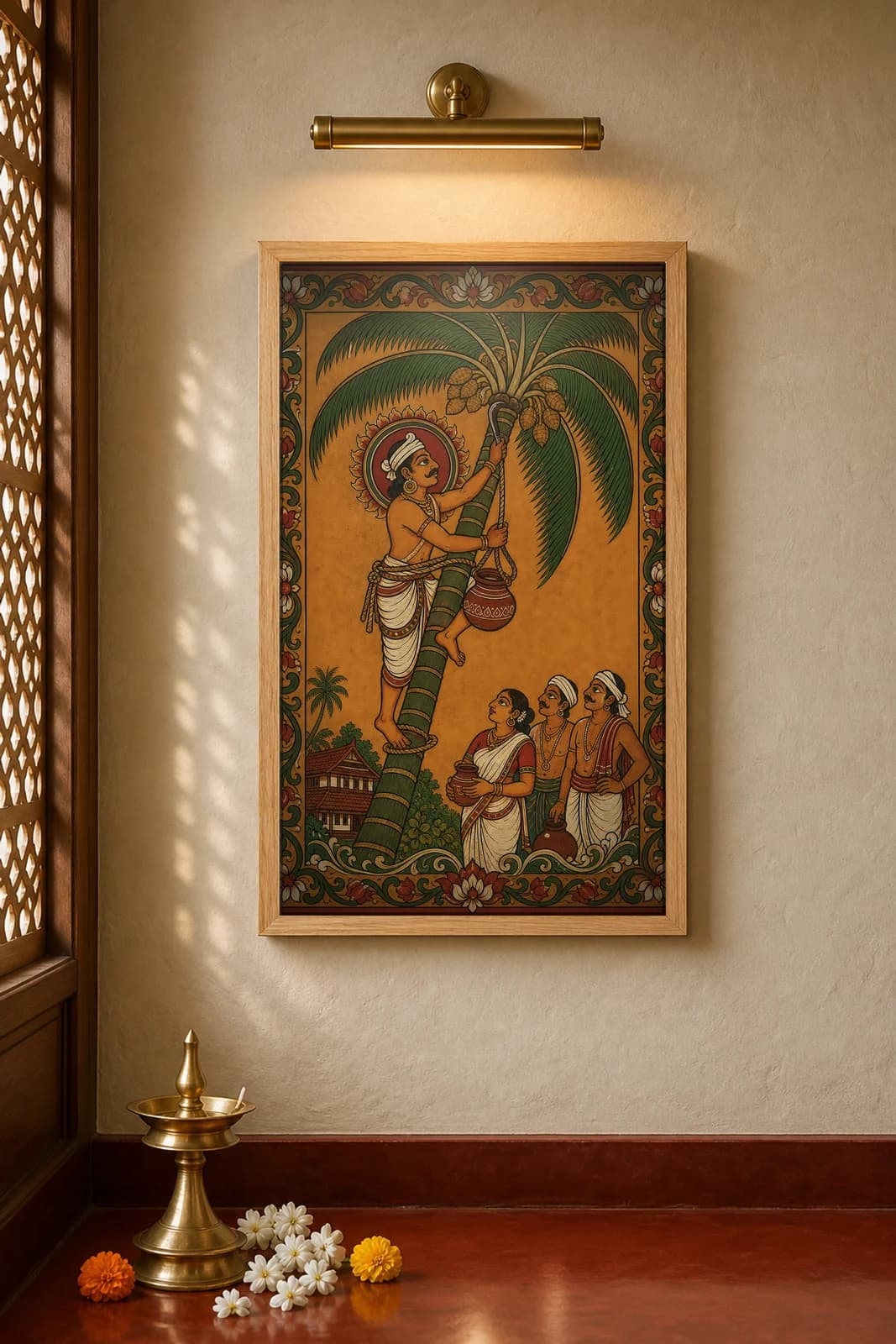
Work Honest — 3 museum-grade prints that set the mood. Rubber is central Kerala's signature plantation crop — the Kottayam–Pala belt is the heart of Indian natural-rubber country — and tapping is skilled dawn work: a shallow spiral cut scored into the bark so latex drips into a cup before the day's heat slows the flow. The picture is built in the idiom of bhitti chitra, Kerala's temple-mural tradition, which uses the panchavarna five-colour system — red, yellow, green, black and white over an ochre ground — in flat opaque fields bounded by a bold lamp-black outline, with the school's signature elongated lotus-shaped eyes. Munnar, high in the Idukki hills, is one of South India's great tea-growing regions, its slopes carpeted with clipped tea bushes since the colonial plantation era; the harvest is hand-plucking — 'two leaves and a bud' — carried in cane baskets slung from a forehead strap, work long done largely by women. The picture is built in the idiom of bhitti chitra, Kerala's temple-mural tradition, which uses the panchavarna five-colour system — red, yellow, green, black and white over an ochre ground — in flat opaque fields bounded by a bold lamp-black outline, with the school's signature elongated lotus-shaped eyes. Toddy tapping is a traditional Kerala trade: the tapper climbs a coconut (or palmyra) palm, binds and cuts the flower spadix, and hangs a pot to collect the sweet sap that ferments into toddy, a daily climb done with little more than a rope and a pot. The picture is built in the idiom of bhitti chitra, Kerala's temple-mural tradition, which uses the panchavarna five-colour system — red, yellow, green, black and white over an ochre ground — in flat opaque fields bounded by a bold lamp-black outline, with the school's signature elongated lotus-shaped eyes.