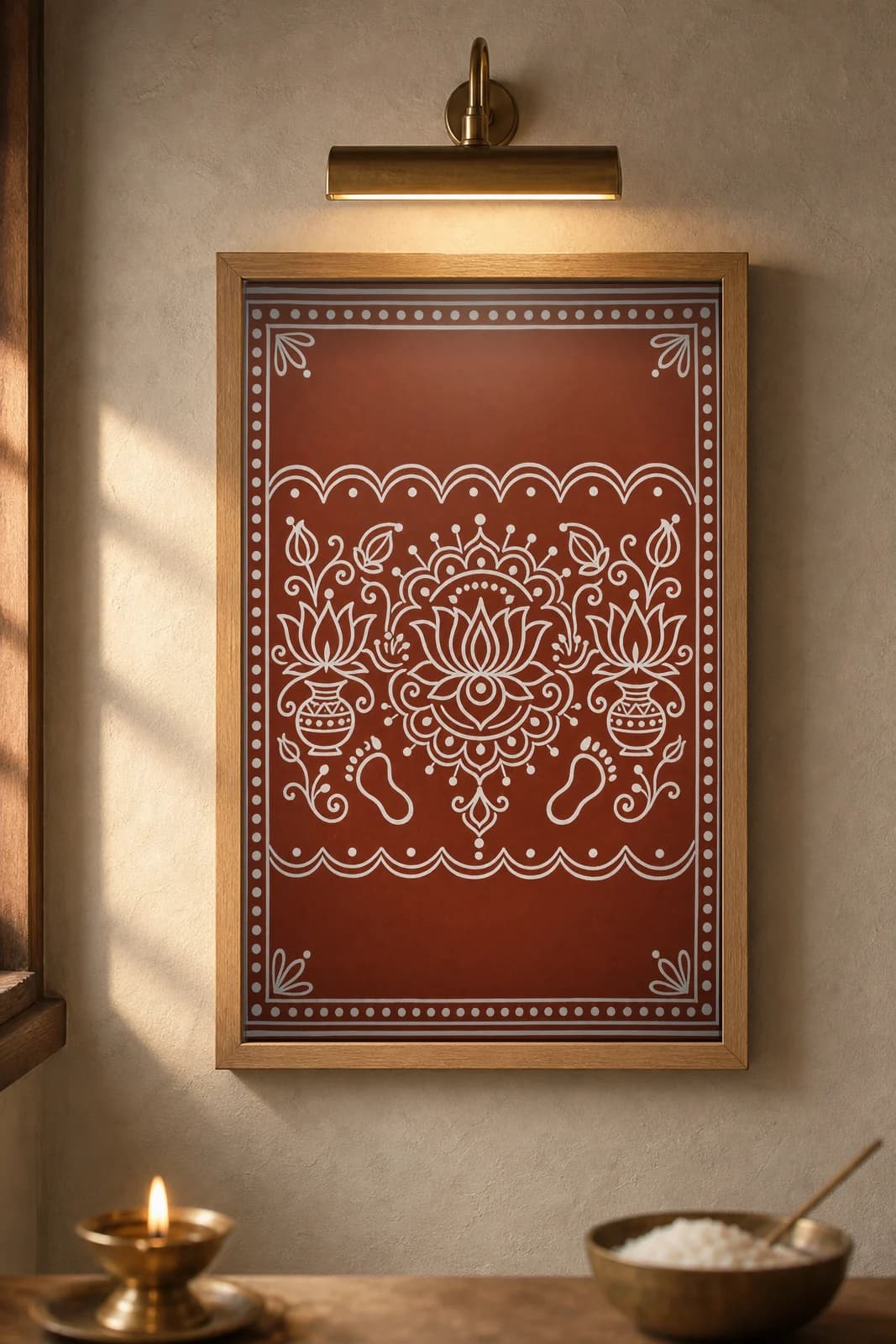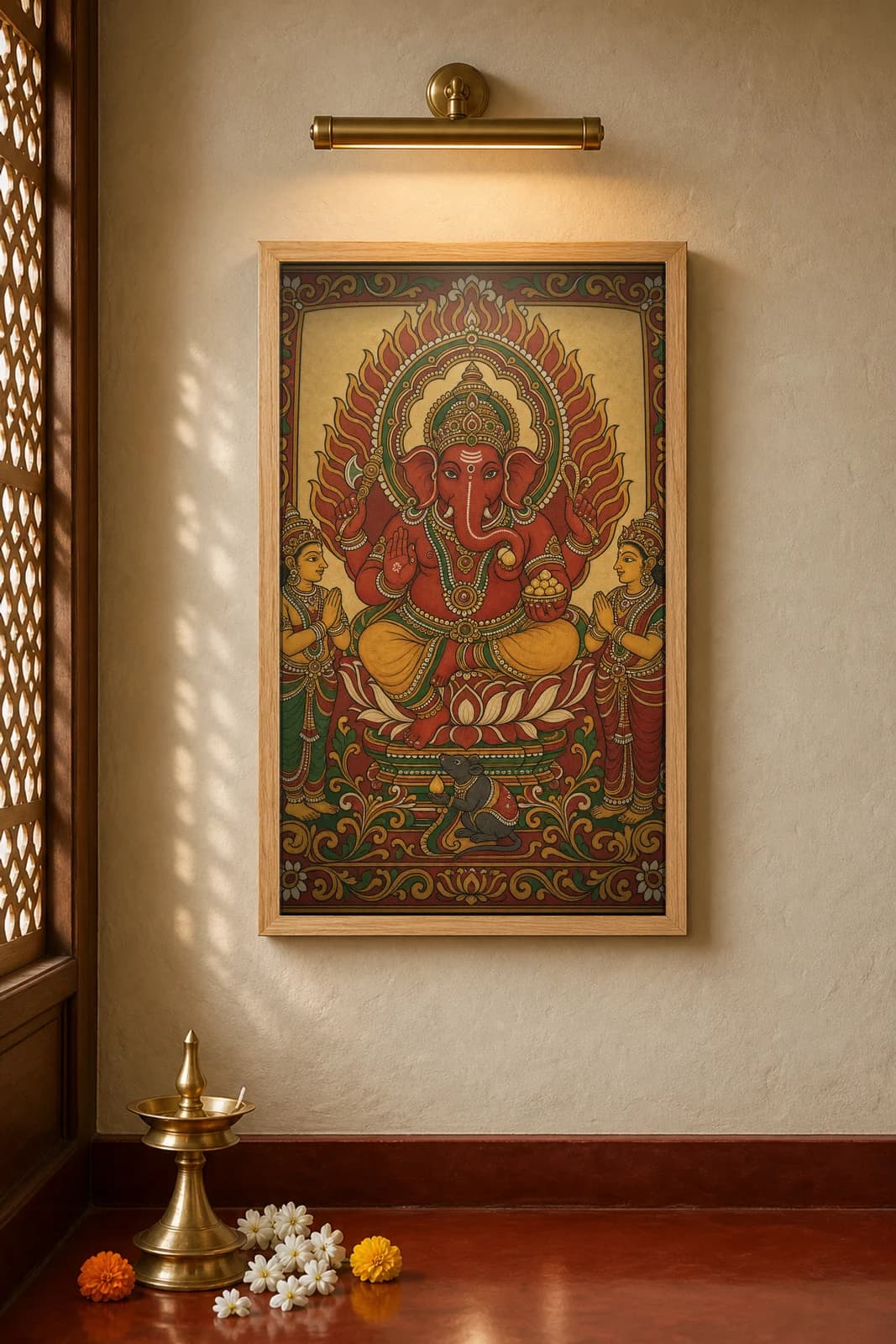
Welcoming — 10 museum-grade prints that set the mood. Aipan is the ritual floor- and wall-art of the Kumaon region of Uttarakhand, made traditionally by Kumaoni women with white rice-paste (biswar) drawn by fingertip onto a geru — red-ochre earth — ground. The dehli (threshold) band is drawn across the base of a doorway as a welcome: the kalash signals abundance, and Lakshmi footprints lead the goddess of prosperity inward across the doorstep into the home. Ganapati — Ganesha, the elephant-headed son of Shiva and Parvati — is Vighnaharta, the remover of obstacles, invoked at the start of any undertaking; his attributes commonly include the modaka, axe (parashu) and noose (pasha), and his vahana is the mouse. He is a beloved subject of bhitti chitra, Kerala's temple-mural tradition that flourished roughly from the 16th to 19th century and is still painted today: flat panchavarna pigments (red, yellow, green, black, white over an ochre ground), a bold lamp-black outline, the flame prabhavali and the school's elongated lotus-shaped eyes. Gond painting comes from the Gond Adivasi communities of central India, with its best-known school formed by the Pradhan Gond of Patangarh and the wider Dindori region of Madhya Pradesh. The contemporary form is largely the legacy of Jangarh Singh Shyam (1962–2001), whose line-and-in-fill manner — every form bounded by a bold outline, then filled with rows of dots, dashes, commas and scales — became known as Jangarh Kalam and was carried on by his family and students.

$49

$49


$49