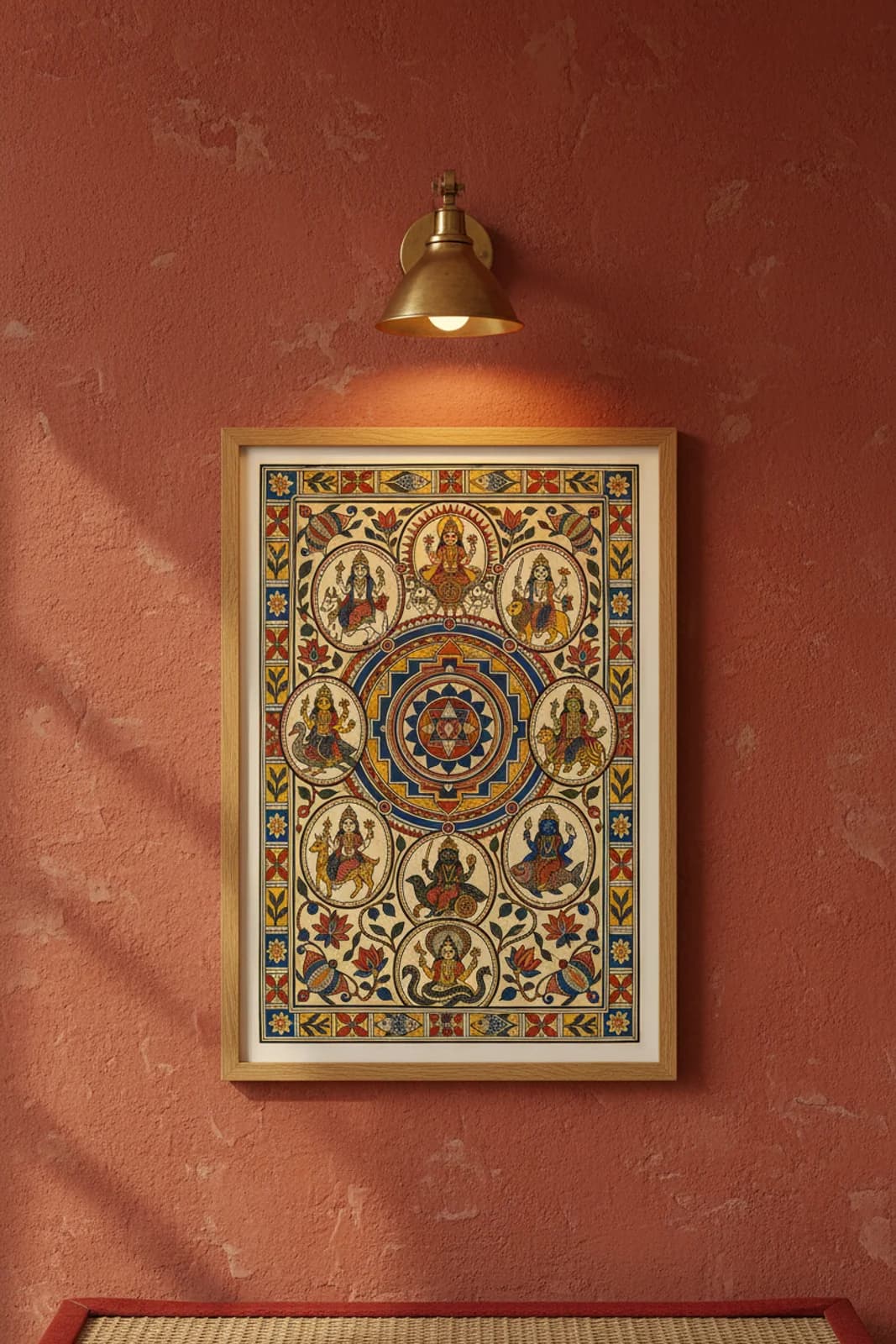
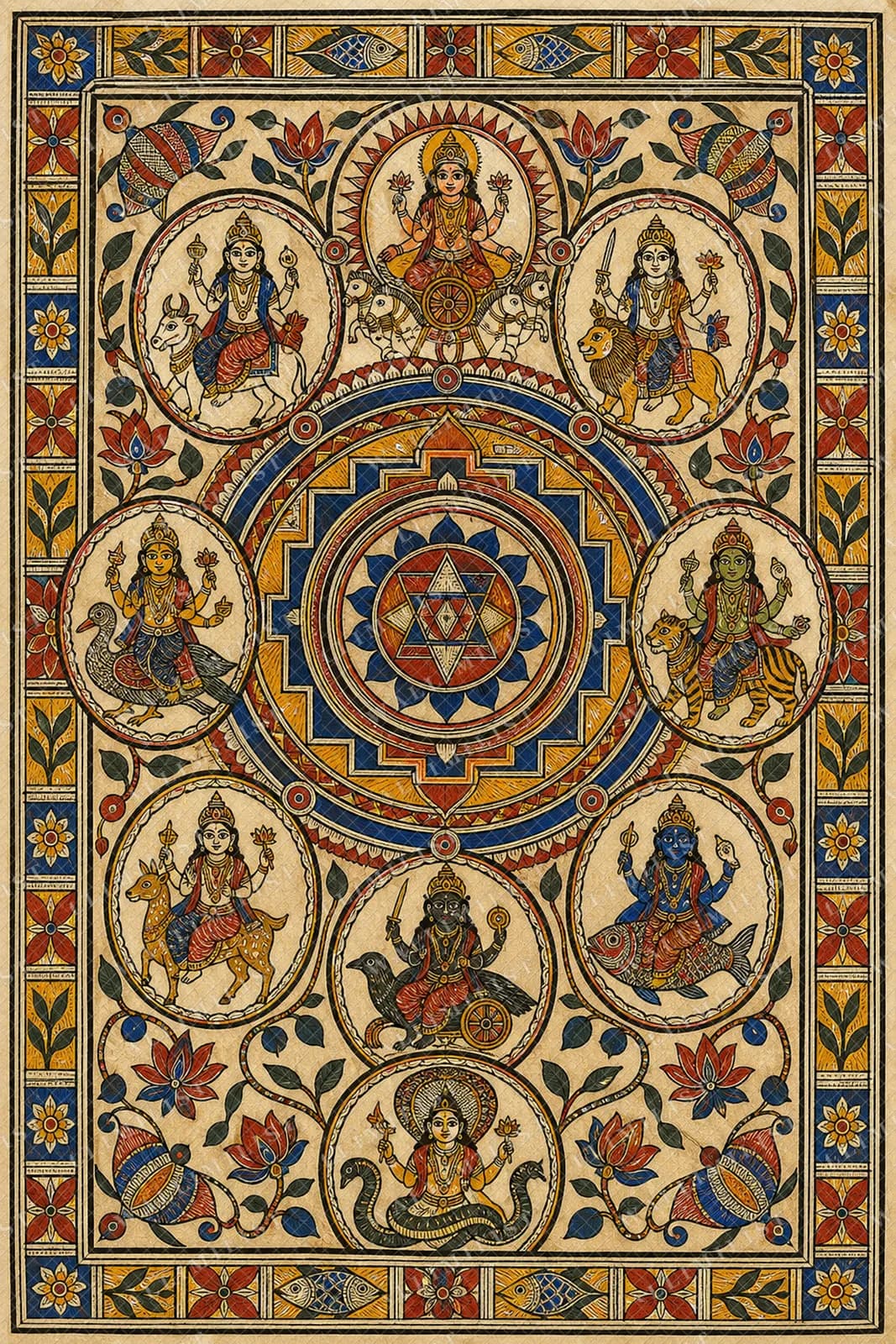
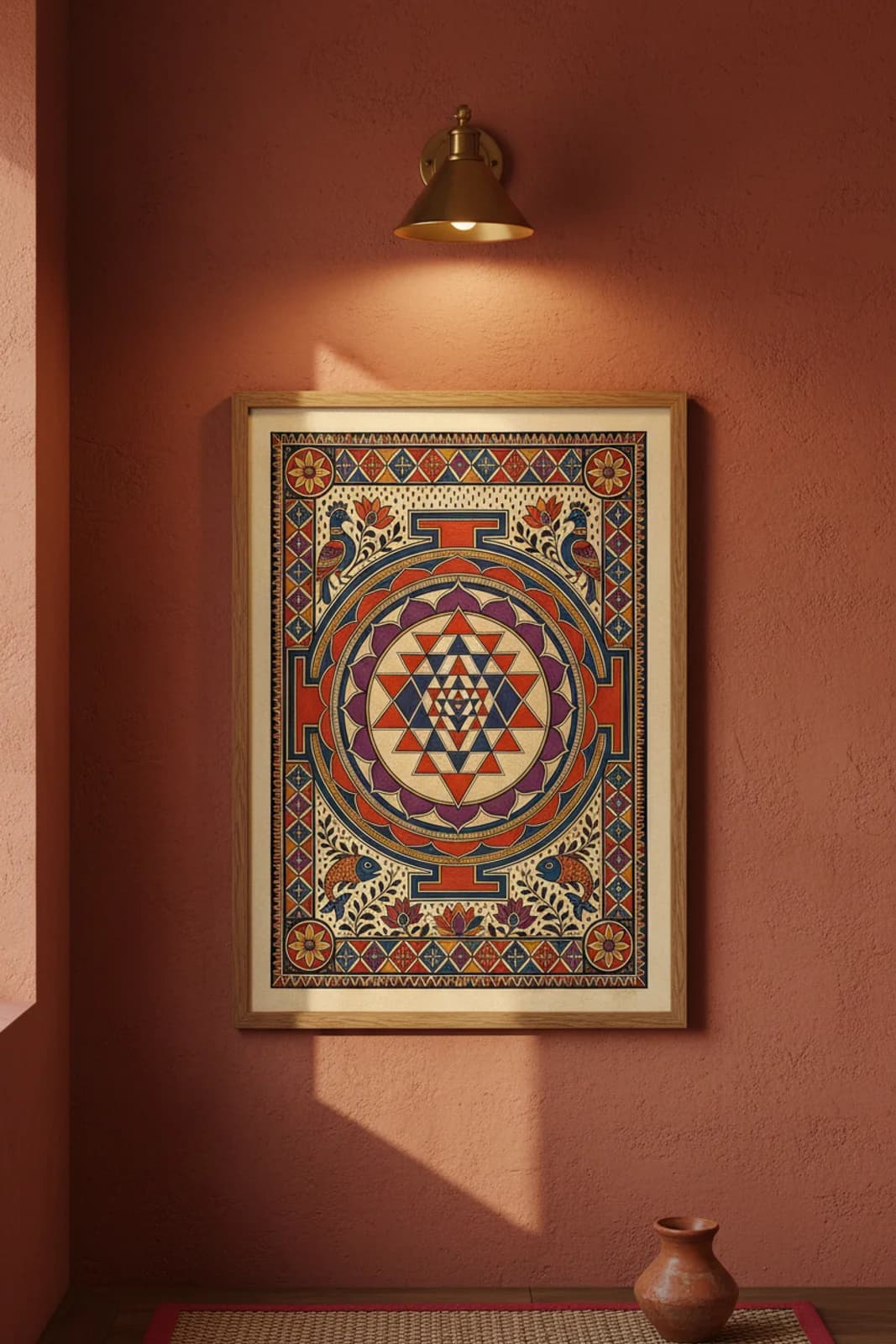
DESIGN BRIEF: Navagraha panels fail when the planets read as a sticker sheet pasted around a generic mandala — Tantrik Madhubani demands that orbit geometry and deity cells share one sacred grammar. Radial-mandala symmetry solves that: the central shatkona yantra with bindu, lotus-petal ring, and stepped bhupura square anchors the composition the way a Sri Yantra anchors temple floor diagrams, while nine equal circular cells sit on a shared orbit ring so Surya crowns the axis at top centre and Ketu drops below the ring without breaking the mandala logic. I kept each graha inside its own medallion with vahana mount visible — chariot horses for Surya, lion for Mangala, tiger for Budha, fish for Brihaspati, bird-drawn chariot for Rahu, serpent tail for Ketu, antelope for Chandra, swan for Shukra, bull for Shani — because Mithila wedding and Aripana traditions paint celestial bodies with human faces and symbolic mounts, not abstract astronomical glyphs. The connecting vine scrolls and lotus fillers between cells borrow Bharni flat colour and Kachni hatch texture without importing full narrative Kohbar scenes; corner kalash-lotus motifs anchor the four directions the way threshold floor art anchors a doorway. Vermillion, indigo, ochre, and green stay within Tantrik palette discipline — bold flat fills, lampblack double outlines, no gradient wash — so the panel reads as ritual geometry translated to wall scale rather than calendar illustration.
 WALLIMILIST