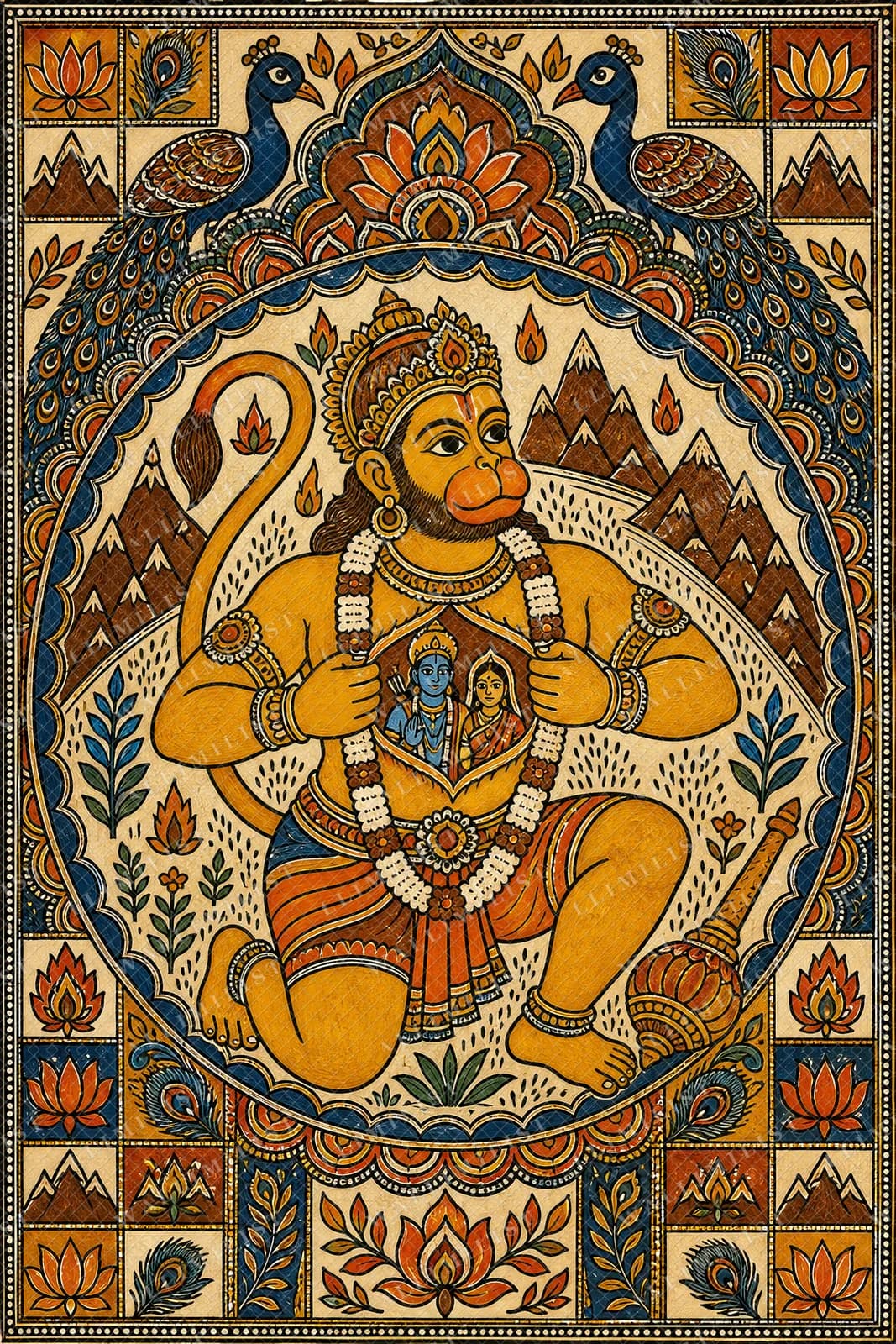
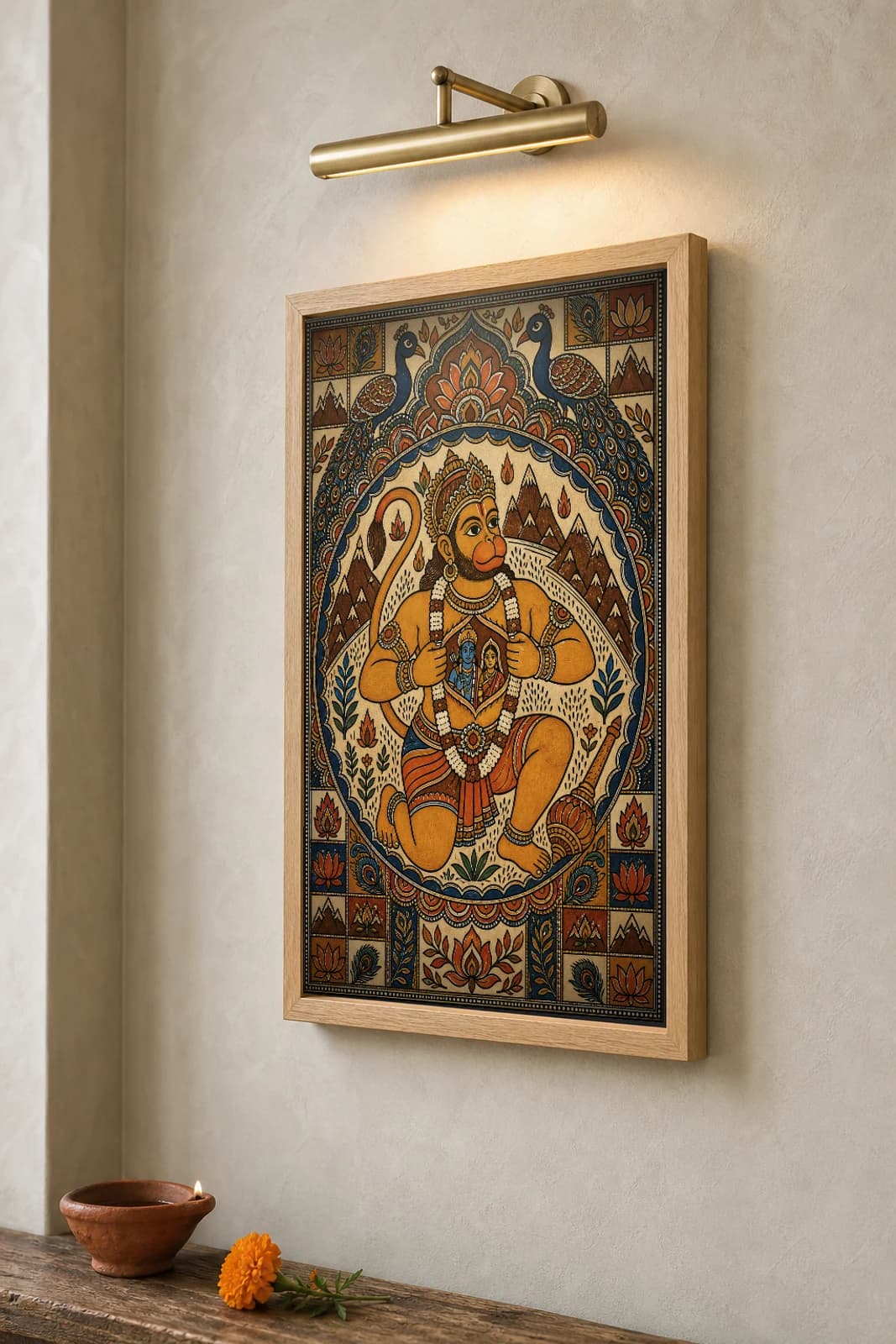
DESIGN BRIEF: The layout problem was how to stage Hanuman's chest-open bhakti moment without turning it into melodrama — the Ramayana episode where he reveals Rama and Sita inside his heart needs a still axis, not a battle narrative. Bharni solved it: Brahmana colour-fill tradition carries the golden skin, vermillion crown, and striped dhoti as flat pigment masses bounded by the same double black stroke used on wedding elephants and Kohbar fish. Central-medallion symmetry was non-negotiable — unlike diagonal procession panels, a kneeling devotion pose needs a circular enclosure so the heart-reveal reads as ritual address to the viewer, not action freeze-frame. The scalloped ring around the scene borrows mandala threshold logic but stays Bharni in execution: concentric colour bands and dot rows rather than Tantrik yantra triangles. Peacocks crown the upper field facing a shared lotus because Mithila pairs beauty and auspicious threshold symbolism; mountain and flame cells in the outer border repeat Himalayan and sacrificial fire grammar from Ramayana folk walls. The gada resting beside his knee anchors strength beside surrender — Hanuman as both warrior and servant. What we kept ritual-accurate: chest-open pose, Rama-Sita heart iconography, kneeling humility, mace attribute. What we compressed: Lanka narrative, flying Sanjeevani episode — this is bhakti portrait, not epic serial.
 WALLIMILIST