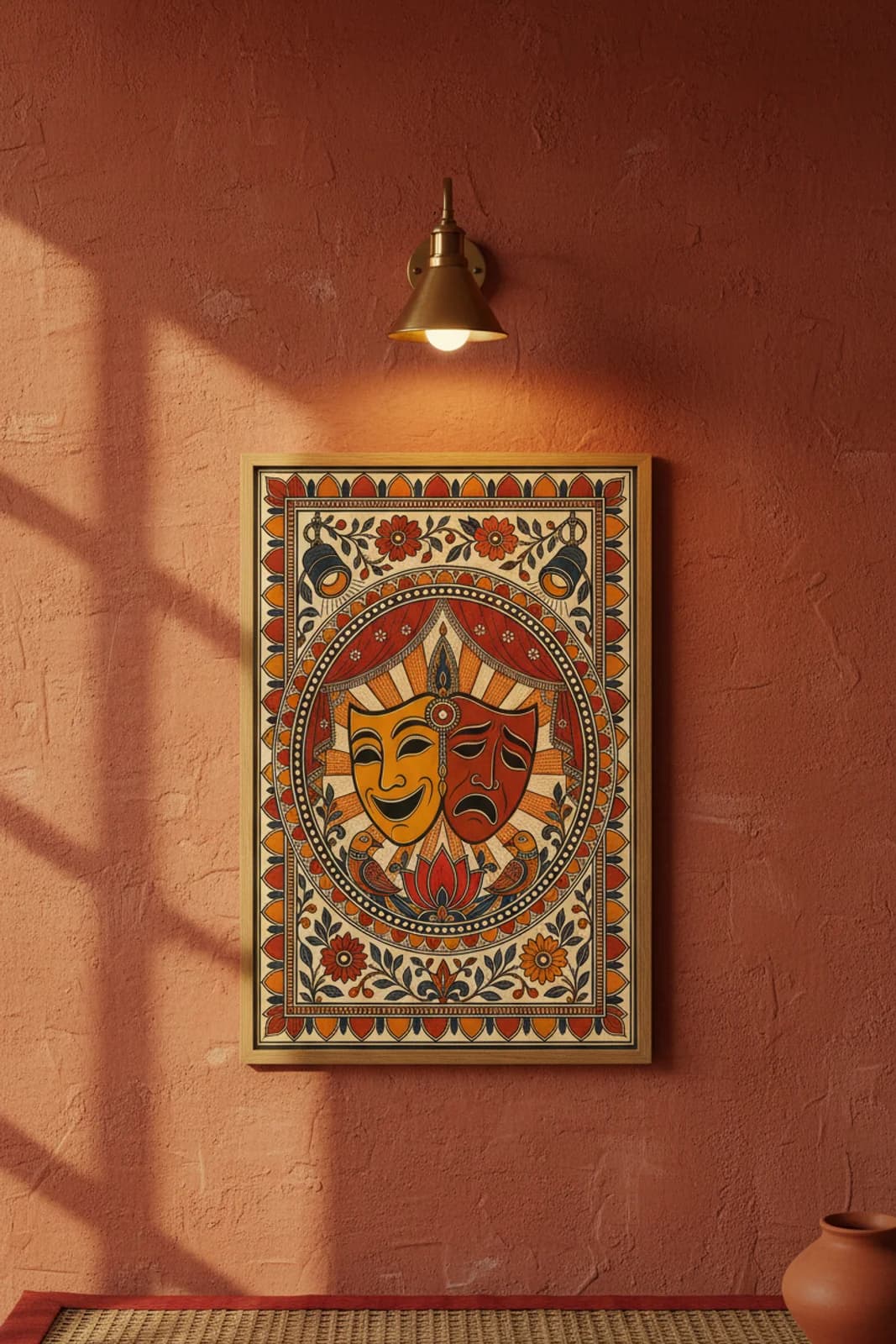
Mumbai Folk Art — 4 museum-grade prints on the theme. Warli painting comes from Warli Adivasi communities of the North Sahyadri — white rice paste on geru walls narrating village life. Mumbai suburban locals — Western and Central line EMUs — are cultural infrastructure connecting Konkan and inland villages to the city; millions commute with the open-door lean that fusion renders as stick figures at carriage thresholds. Bharni is the Brahmana women's filling tradition within Madhubani painting — historically distinct from Kayastha Kachni line work. Where Kachni builds shade through parallel hatching, Bharni declares in vermillion, cobalt, ochre, and lampblack solids bounded by bold double outlines — the style traditionally served deities, peacocks, fish, and wedding-procession scenes on interior walls. Bharni — meaning to fill — is the Brahmin women's colour tradition within Madhubani painting from the Mithila region of Bihar and adjoining Nepal: bold lampblack outlines enclosing saturated flat fields of vermillion, turmeric, cobalt, orange, and green, historically depicting deities, peacocks, fish, wedding-procession scenes, and village festival vignettes on cow-dung-washed interior walls. Comedy and tragedy masks derive from ancient Greek theatre but became a universal performing-arts symbol adopted by Mumbai's Marathi, Hindi, and English-language stages from Prithvi Theatre to the NCPA — this fusion piece translates that metropolitan stage icon into Bharni central-medallion grammar rather than claiming affiliation with any specific troupe, mask-maker, or institutional crest.