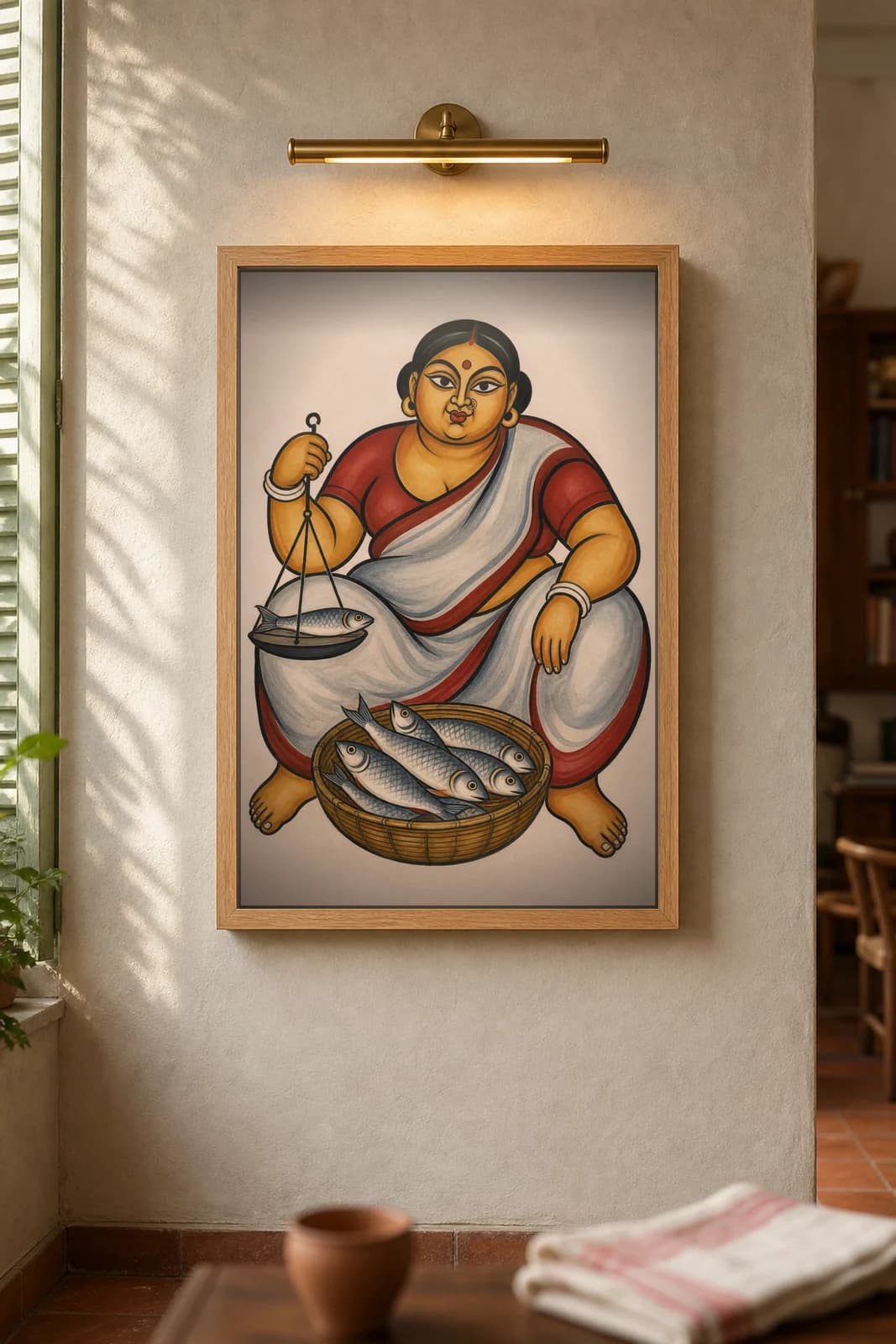
Cafe — 52 museum-grade prints sized and toned for the room. Kalighat Pat grew up in 19th-century Kolkata, painted by migrant patua (chitrakar) scroll-painters who settled near the Kalighat Kali temple and sold quick watercolour souvenirs to pilgrims. Working on mill-made paper with a bold single black brush outline and soft 'boneless' shaded strokes on a plain ground, they painted gods and goddesses alongside what is often called India's first modern social satire — sharp, affectionate caricatures of the colonial 'babu' and the hypocrisies of Calcutta life. Aipan is the ritual floor- and wall-art of the Kumaon region of Uttarakhand, made traditionally by Kumaoni women with white rice-paste (biswar) drawn by fingertip onto a geru — red-ochre earth — ground, at thresholds, courtyards and household shrines. Drawing an everyday hearth scene as a centred chowki extends Aipan's seat-diagram grammar to daily life rather than only festival rites. Kerala's Malabar coast was the hinge of the global spice trade for two millennia — black pepper, cardamom and cinnamon drew Roman, Arab, Chinese and later European ships to Kochi, Kozhikode and Kollam. This print sets that everyday merchant inside bhitti chitra, Kerala's temple-mural tradition that flourished roughly from the 16th to 19th century and is still painted today: flat panchavarna pigments (red, yellow, green, black, white over an ochre ground), a bold lamp-black outline, and the school's elongated lotus-shaped eyes.