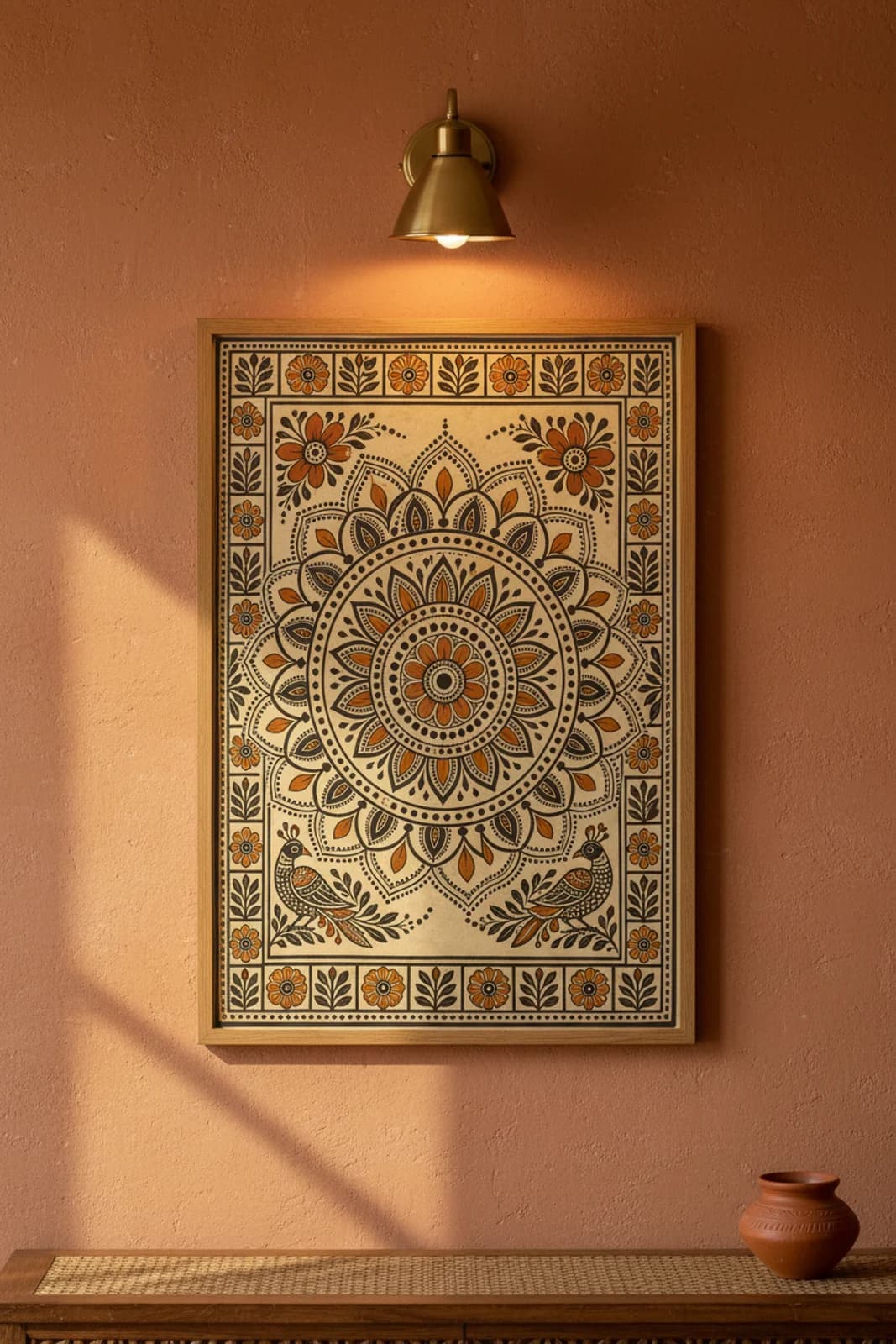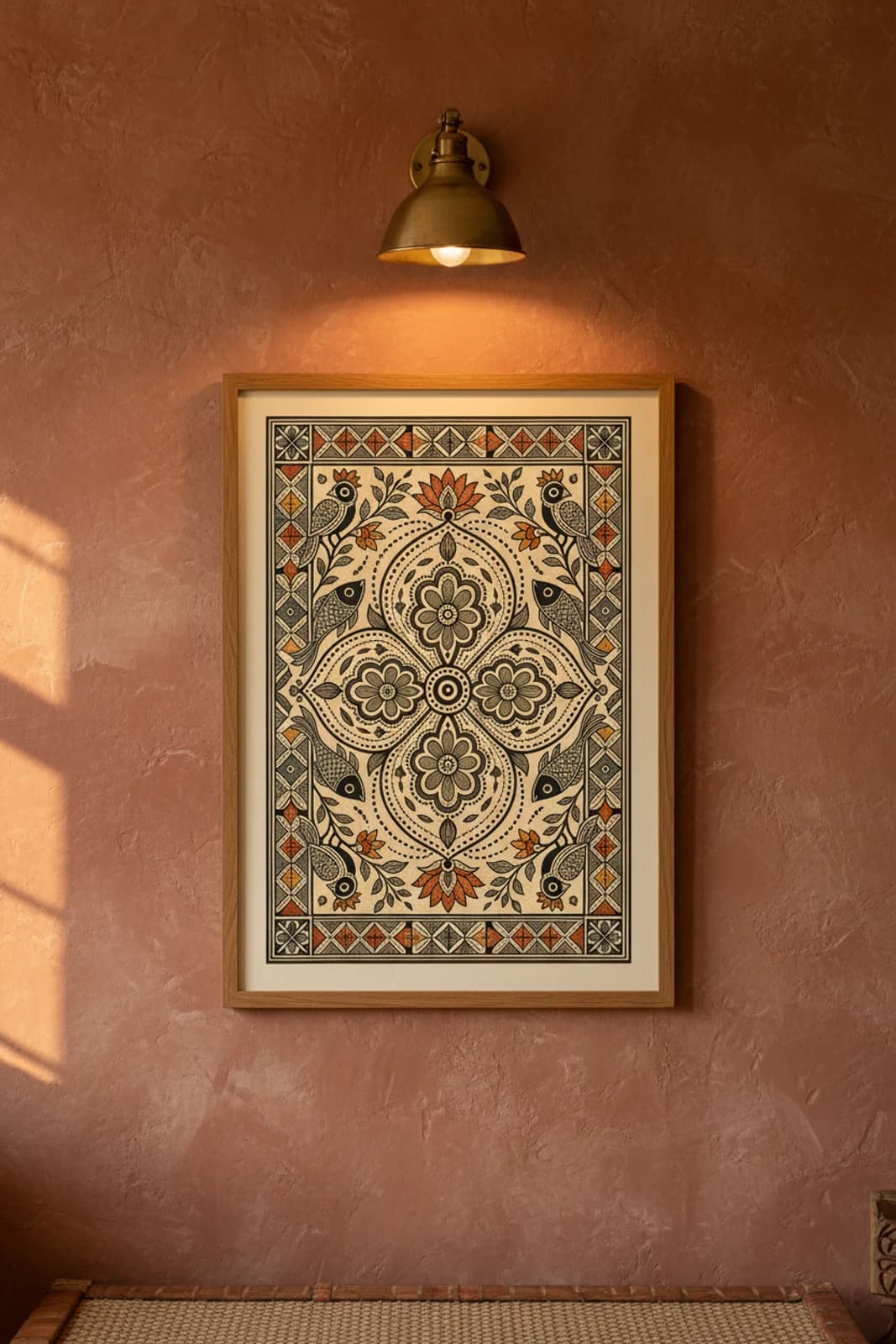
Pattern Dense — 4 museum-grade prints that set the mood. Godna — from the Maithili word for tattoo — is one of five historically distinct Madhubani styles, rooted in the ritual body-art tradition of Dalit Dusadh women in the Mithila region of Bihar. Where Bharni and Kohbar panels in upper-caste households favoured saturated deity narrative, Godna preserved a sparser vocabulary of concentric circles, dash grids, dot clusters, and repeated faunal motifs inked on arms, legs, and forehead as identity and protection marks before migrating to handmade paper. Madhubani — Mithila painting from the Mithila region of Bihar and adjoining Nepal — traditionally covered courtyard and interior walls for weddings, festivals, and seasonal rites, with knowledge passed matrilineally. Godna within Mithila derives from the ritual tattoo tradition practised especially by Dalit Dusadh women, who historically worked in a sparser black-and-white dot-and-line vocabulary distinct from the saturated Bharni panels of Brahmin households. Godna — meaning ritual tattoo — is the Madhubani style rooted in Dalit Dusadh women's body-art tradition in the Mithila region of Bihar, distinct from the saturated Bharni deity panels of Brahmin households. Historically, Natins (women of the Nat community) tattooed Dusadh women with lampblack or kohl using needle bundles; motifs included bundi dot clusters, chudi concentric bangle rings, floral wrist bands, and protective faunal marks on forehead, ankle, and arm.