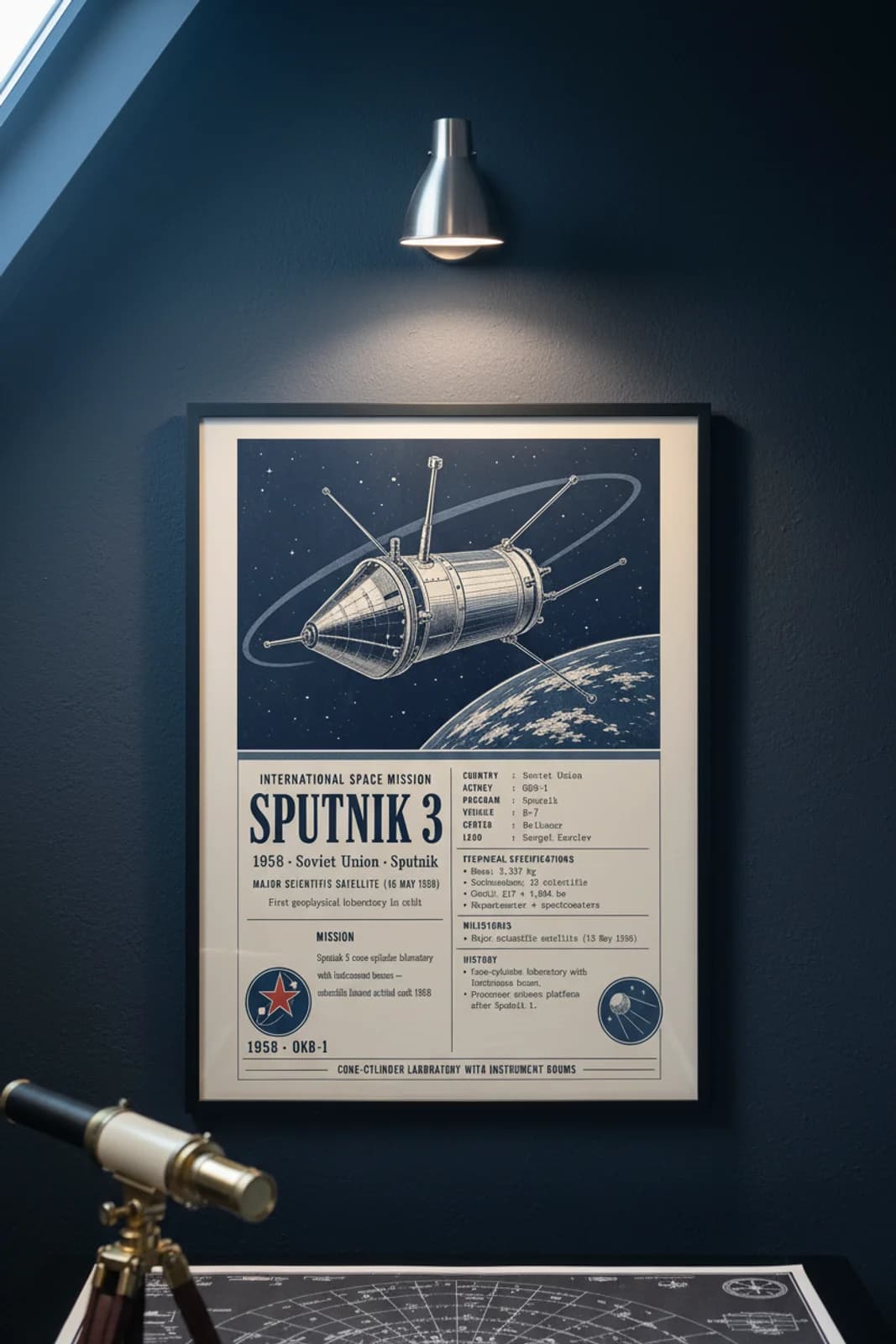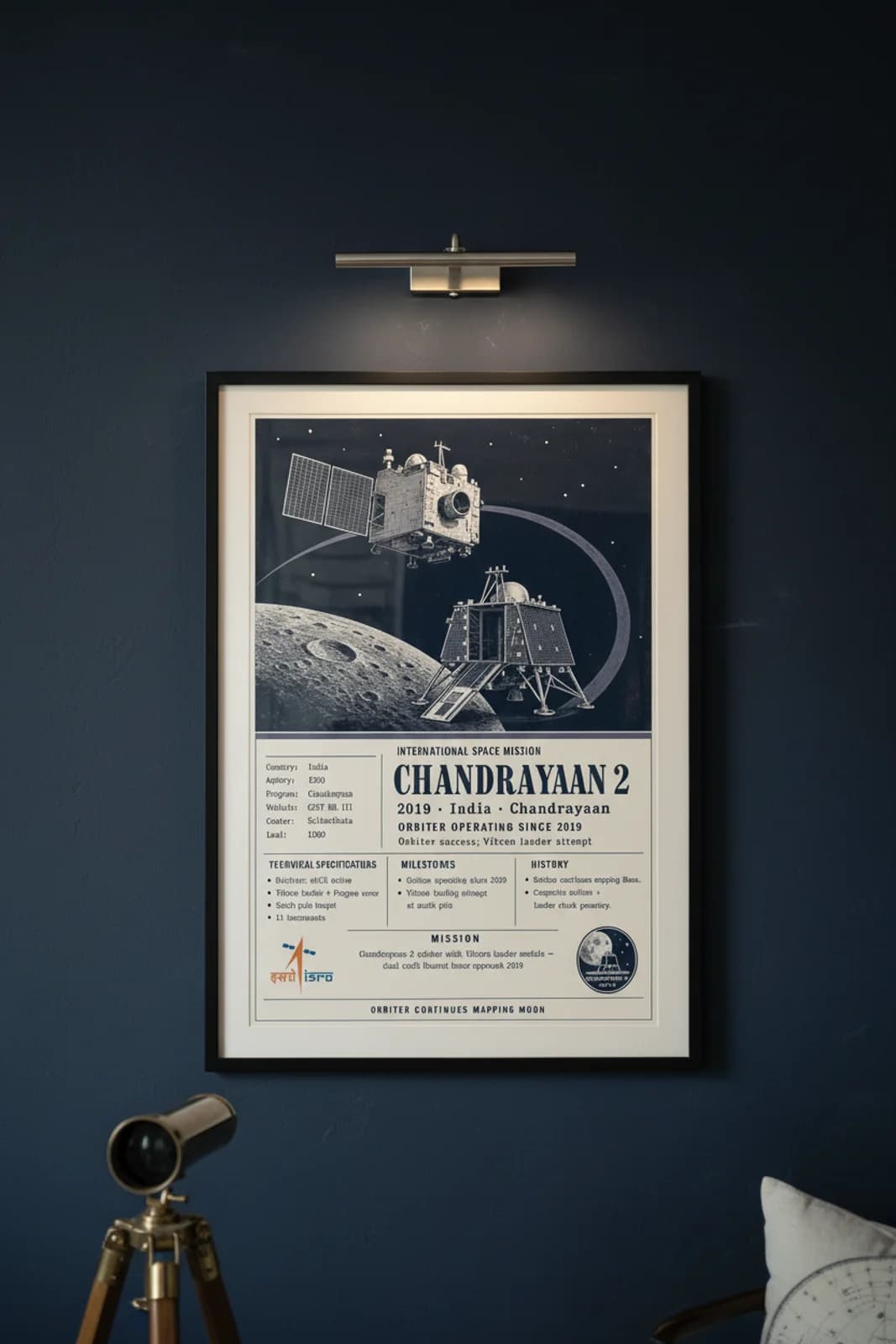
Horizontal Band Archive — 3 museum-grade prints that set the mood. Sputnik 3 represented the Soviet Union's pivot from propaganda payloads to serious geophysical research — a 1,327-kilogramne laboratory that carried more scientific instrumentation than any previous satellite and operated until April 1960. Its magnetometer and spectrometer data contributed to early understanding of Earth's radiation environment, and its cone-cylinder bus architecture became the template for subsequent Soviet scientific satellites including the Elektron and Prognoz series. Chandrayaan-2 placed India in direct competition with Israel's Beresheet and Russia's Luna 25 for south pole landing prestige — a region every major space power now targets for water-ice resources. Vikram's landing anomaly became a national teaching moment broadcast live across India, while the orbiter's continued operations delivered valuable mapping data and demonstrated mission resilience. Oceansat-2 extended ISRO's Earth observation portfolio from land mapping and weather into the marine domain — a capability critical for a nation with 7,500 kilometres of coastline and one of the world's largest fishing economies. Ocean color data helps identify productive fishing zones and monitor algal blooms, while scatterometer wind measurements improve cyclone intensity forecasting in the Bay of Bengal and Arabian Sea.

$49


$49