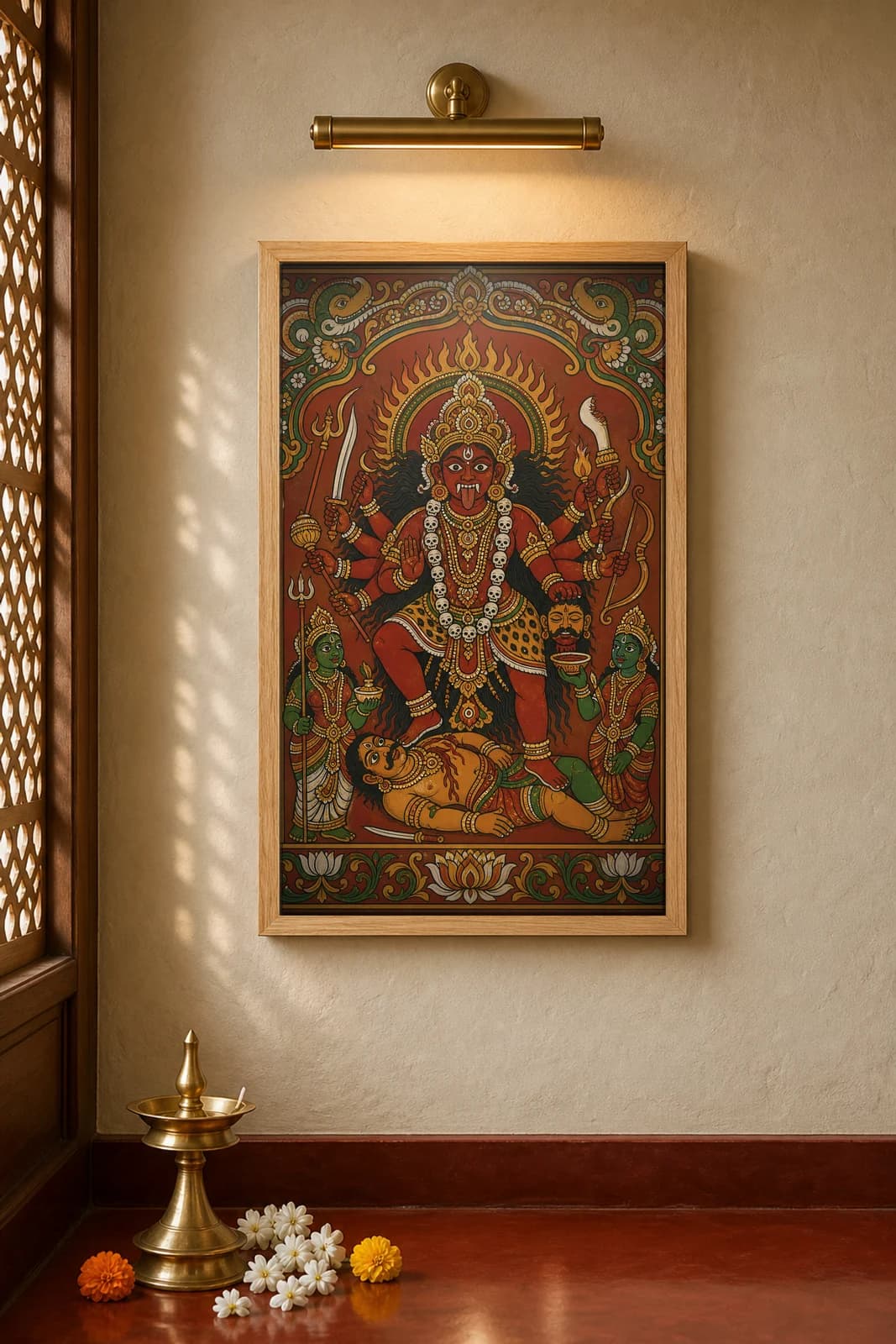
Dramatic — 8 museum-grade prints that set the mood. Bhadrakali — the fierce form of the Goddess born to slay the demon Darika — is the presiding deity of countless Bhagavati kavus across Kerala, and her myth is enacted in temple rituals and in Mudiyettu, a ritual theatre recognised by UNESCO. In bhitti chitra, Kerala's temple-mural tradition (flourishing roughly 16th–19th century and still painted today), she is shown red-bodied with a flame crown, protruding tongue and skull garland. Kalaripayattu, practised in the kalari training pit, is among the oldest martial traditions of India, native to Kerala and combining strikes, leaps, weapons and a deep link to healing and devotion — training often begins with obeisance at the kalari's shrine lamp. This print sets a sword-and-shield bout inside bhitti chitra, Kerala's temple-mural tradition that flourished roughly from the 16th to 19th century and is still painted today: flat panchavarna pigments (red, yellow, green, black, white over an ochre or red ground), a bold lamp-black outline and the school's elongated lotus-shaped eyes. Narasimha is the fourth avatar of Vishnu — the man-lion who emerges at twilight from a pillar to kill the demon king Hiranyakashipu, neither man nor beast, neither inside nor outside, neither day nor night, closing every clause of the demon's boon to protect his devotee Prahlada. He is a recurring subject of bhitti chitra, Kerala's temple-mural tradition, which uses the panchavarna five-colour system — red, yellow, green, black and white over an ochre or red ground — in flat opaque fields bounded by a bold lamp-black outline, with the school's signature elongated lotus-shaped eyes.

$49


$49

$49