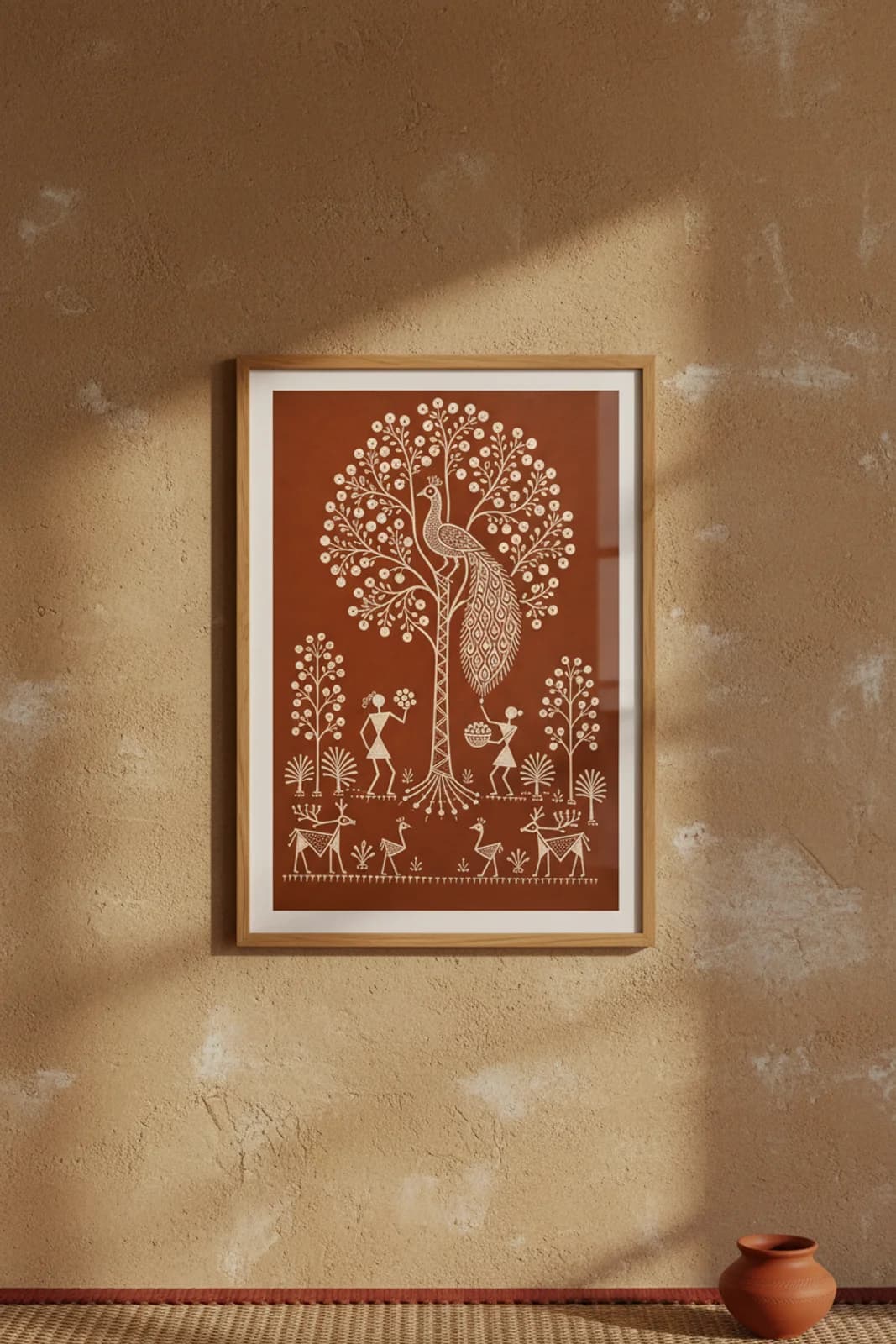
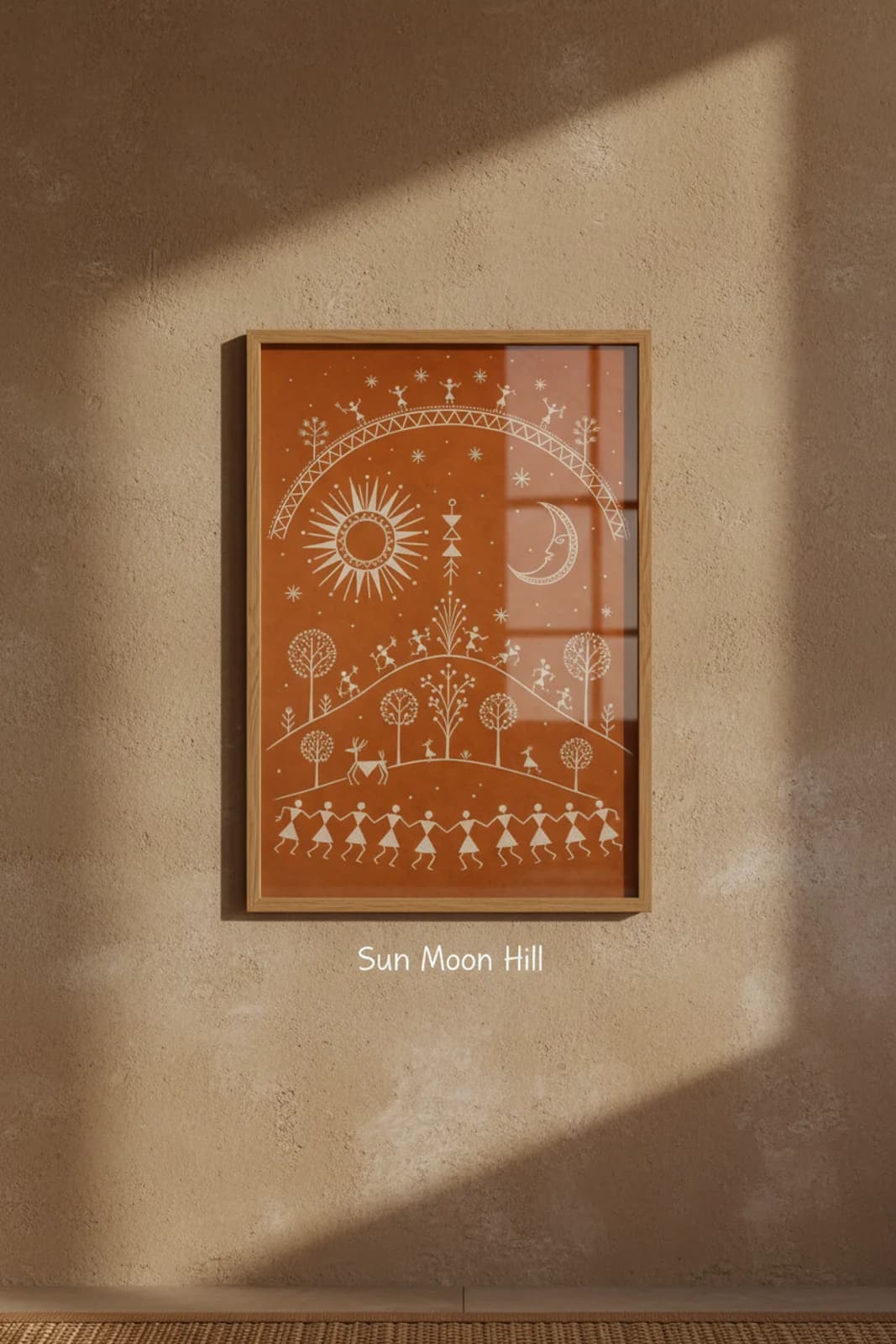
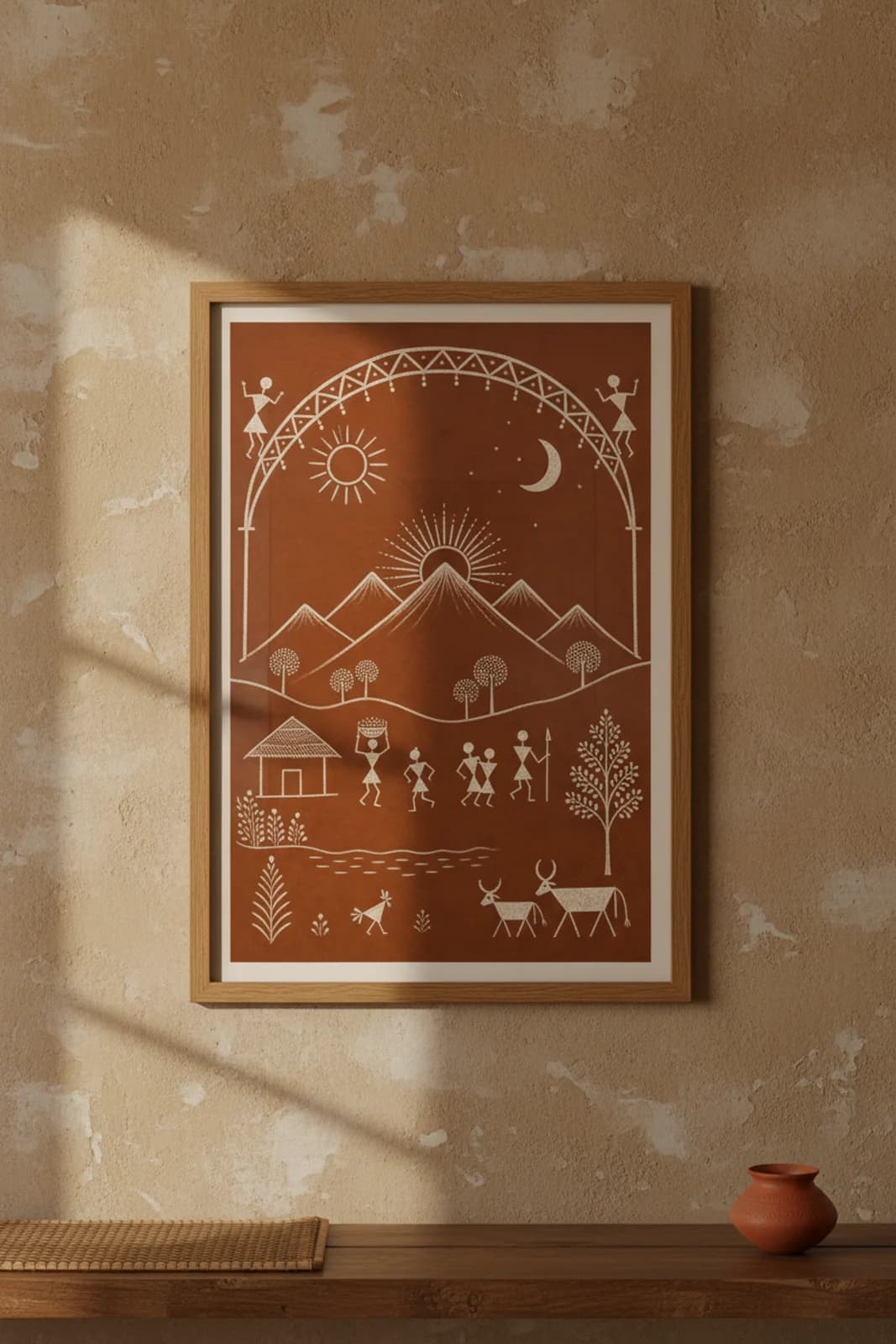
DESIGN BRIEF: Evening flock scenes in Warli fail when they borrow tarpa spiral grammar — birds circling a musician reads as ritual dance, not forest return. Sun-moon-arch symmetry solves that: the decorative arch frames a celestial band without forcing concentric human rings, so the hero read stays avian migration at dusk. I placed the large central sun directly under the arch apex because Talasari panels treat the setting disc as the day's last threshold — not a generic tourist sun-moon-hut stack, but a single dominant orb with alternating ray lengths that echo bamboo-stick unevenness. The eighteen birds fly in an upward V-swoosh beneath that sun rather than a closed circle, because closed rings belong to harvest dance or feast seating in this catalog; an open arc preserves direction — left to right, sky to hill — without implying tarpa. Corner sun and crescent moon balance the arch laterally the way classical Warli walls pair day and night guardians above daily-life bands below. I refused chauk geometry here — no marriage square, no Palghat pot — because forest-life density stays light and the narrative is pastoral return: herder with staff, firewood carrier, goats on the path, circle-canopy trees on rolling hills, river wavy-lines in the valley. Triangle bodies, circle heads and tree crowns, square hut grammar absent — only the stick-line forest band the brief demanded.
 WALLIMILIST