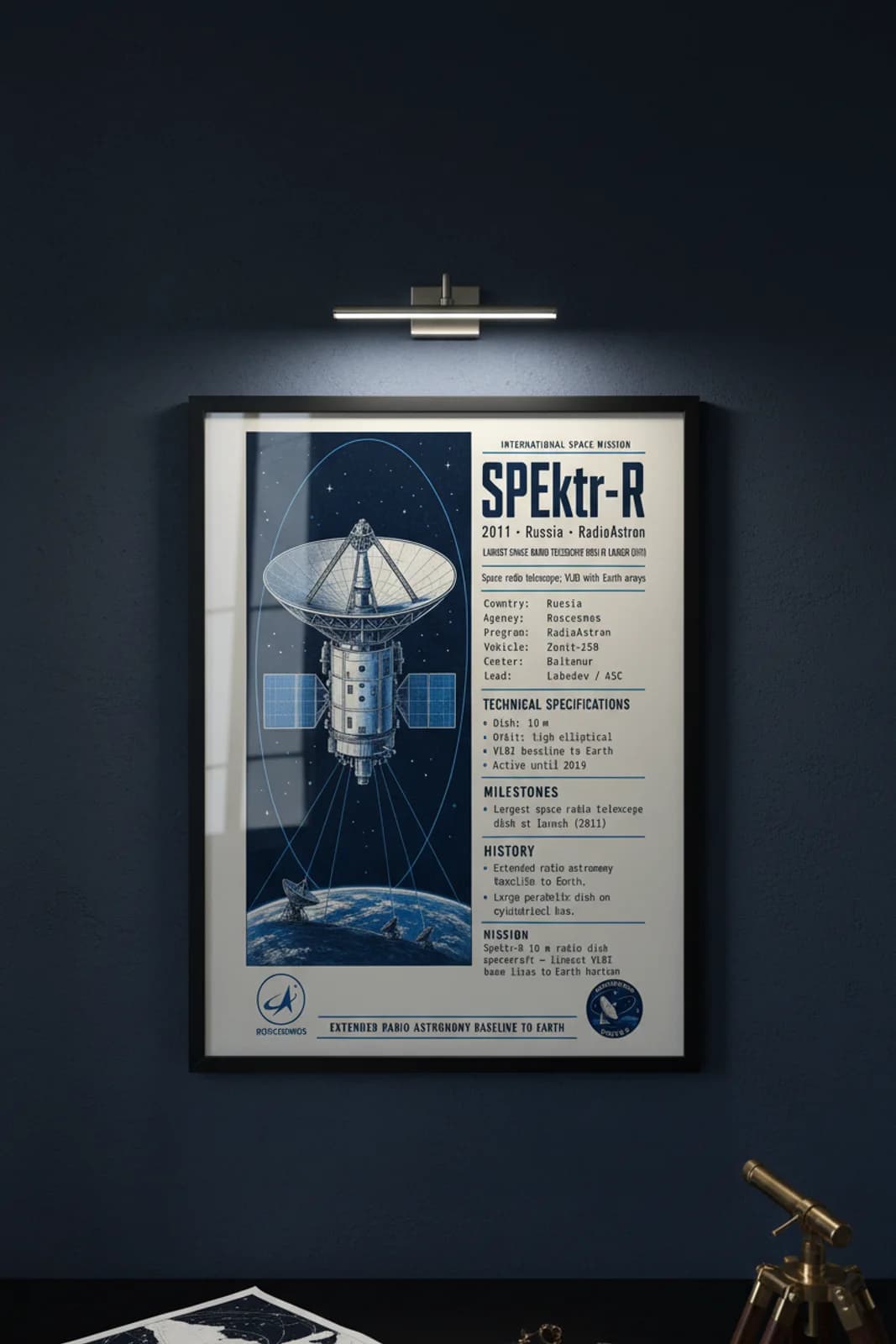
Rank 19 documents Spektr-R — Russia's RadioAstron space radio telescope that extended very-long-baseline interferometry to a 10-metre orbital dish, creating Earth-space baselines that dwarfed ground-only arrays. Launched 18 July 2011 aboard Zenit-2SB from Baikonur, the Lebedev Institute and Astro Space Center collaboration placed a massive parabolic antenna on a high elliptical orbit, pairing with terrestrial radio telescopes from Russia, Europe, Japan, and the United States to resolve quasars, black hole environments, and interstellar masers at unprecedented angular resolution. Active until contact loss in January 2019, Spektr-R demonstrated that a single space dish could multiply the effective aperture of Earth's radio astronomy network — a VLBI architecture that future missions study for next-generation orbital arrays. Wallimilist renders the 10-metre dish hero, cyan VLBI beam lines to ground telescopes, split-manifesto cream-navy layout with SPEKTR-R slab title, LARGEST SPACE RADIO TELESCOPE DISH AT LAUNCH kicker, and EXTENDED RADIO ASTRONOMY BASELINE TO EARTH footer exactly as the master PNG dictates — Roscosmos and RadioAstron emblems, specimen data bands, and curator copy on space radio astronomy heritage.
 WALLIMILIST