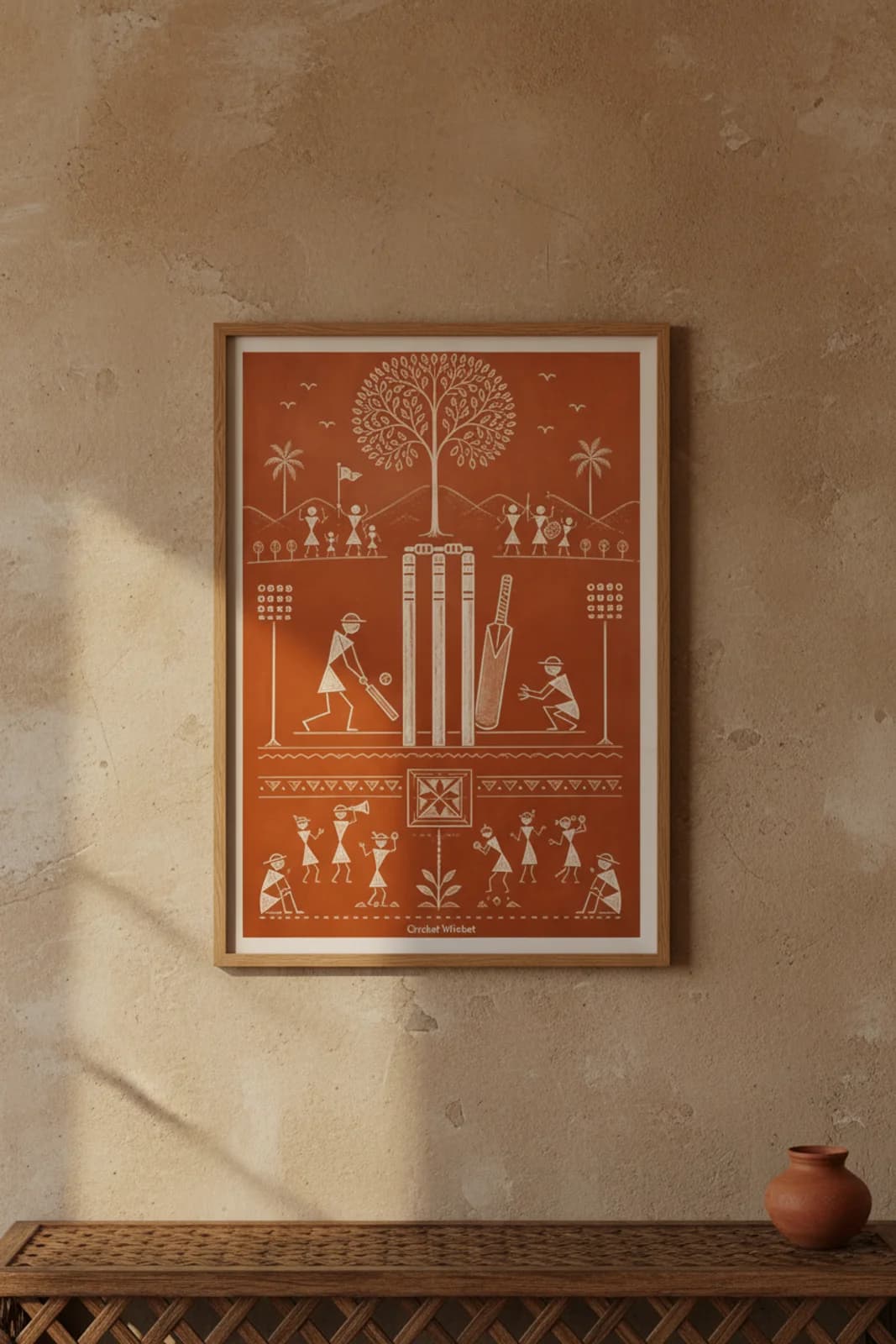
The brief was a translation problem dressed as a national religion: how do cricket stumps, a swinging bat, and stadium floodlights read inside Warli white-line grammar without smuggling in a tarpa dance spiral that belongs on harvest nights, not Wankhede replays? Vertical-axis symmetry was the layout fix — three stump rectangles stacked centre with bail lines crossing like chauk geometry, bat leaning as triangle wedge, batsman and keeper as capped triangle bodies flanking the pitch band the way classical Warli places offering bearers beside a sacred square. What we refused: perspective stadium seating, team logos, realistic kit shading, and any concentric dance ring as default composition. What we kept legible: floodlight grid poles left and right as minimal urban stadium hint, tree-of-life and palm backdrop as village-ground memory, spectator stick clusters with flag and dhol as match-day crowd energy, and a lower chauk square with geometric star interior to frame cricket inside marriage-border tradition. Light-mid density preserves ochre wall breath — the empty ground between floodlights and stumps is part of the brief, not unfinished canvas.
 WALLIMILIST