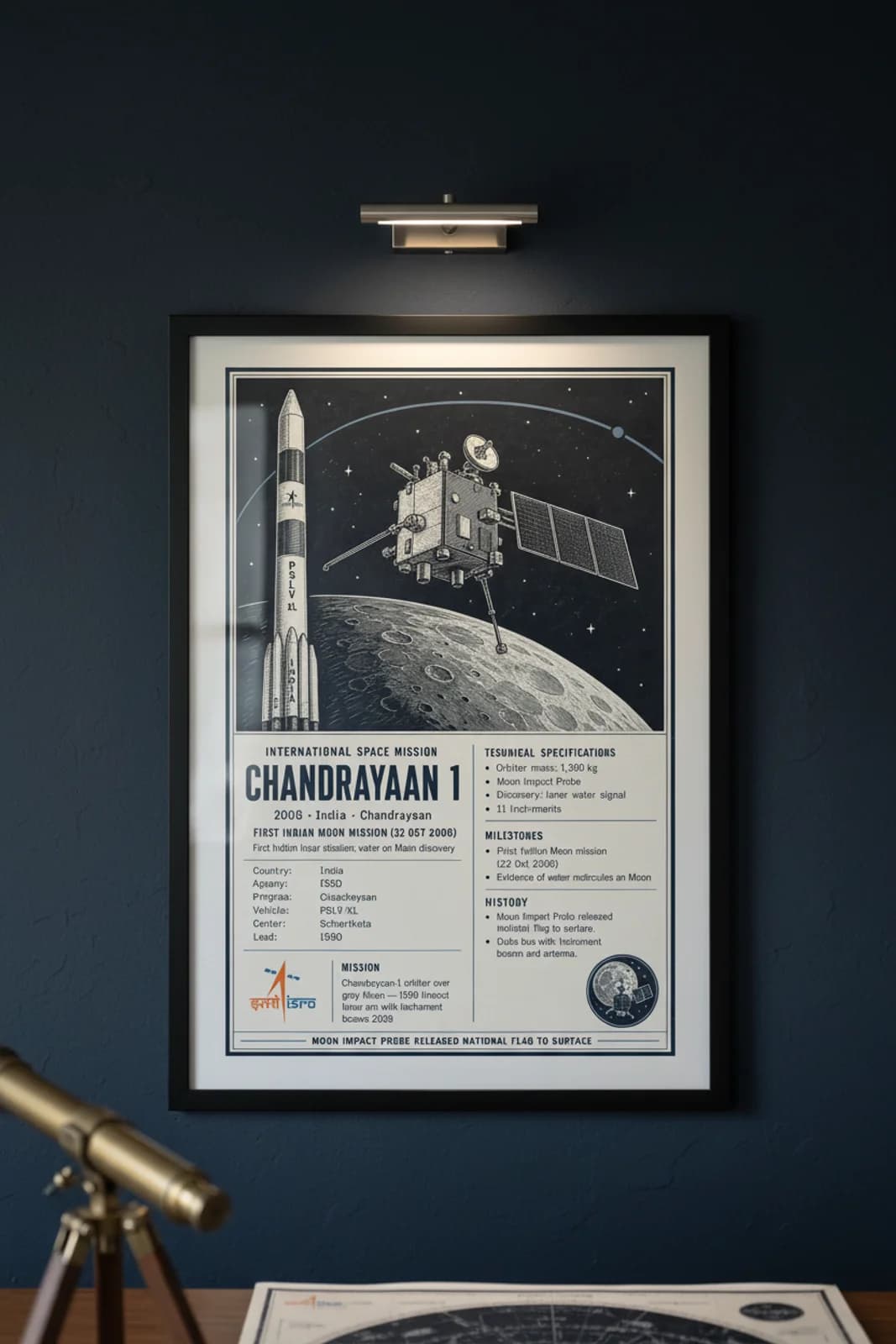
Rank 24 documents Bhaskara 1 — India's first Earth observation satellite and the mission that opened ISRO's remote sensing programme for agricultural, hydrological, and geological resource planning. Launched 7 June 1979 aboard Kosmos-3M from Kapustin Yar, the 444-kilogramne box-shaped bus carried a television camera and microwave radiometer that mapped India's landmass from low Earth orbit — delivering imagery for crop assessment, soil moisture monitoring, and geological survey applications that ground-based mapping could not match at national scale. Named for the twelfth-century mathematician Bhaskara II, the mission followed Aryabhata's 1975 debut by proving ISRO could build purpose-specific observation platforms rather than general-purpose science buses. Two years of operations provided the remote sensing foundation that led to IRS-1A, Resourcesat, and India's world-class Earth observation constellation. Wallimilist renders the box-shaped EO bus with camera aperture, Indian subcontinent horizon, split-manifesto green-cream layout with BHASKARA 1 slab title, FIRST INDIAN REMOTE SENSING SATELLITE kicker, and MAPPED INDIA FROM ORBIT FOR RESOURCE PLANNING footer exactly as the master PNG dictates — ISRO logo, Bhaskara 1 mission emblem, specimen data bands, and curator copy on Indian remote sensing heritage.
 WALLIMILIST