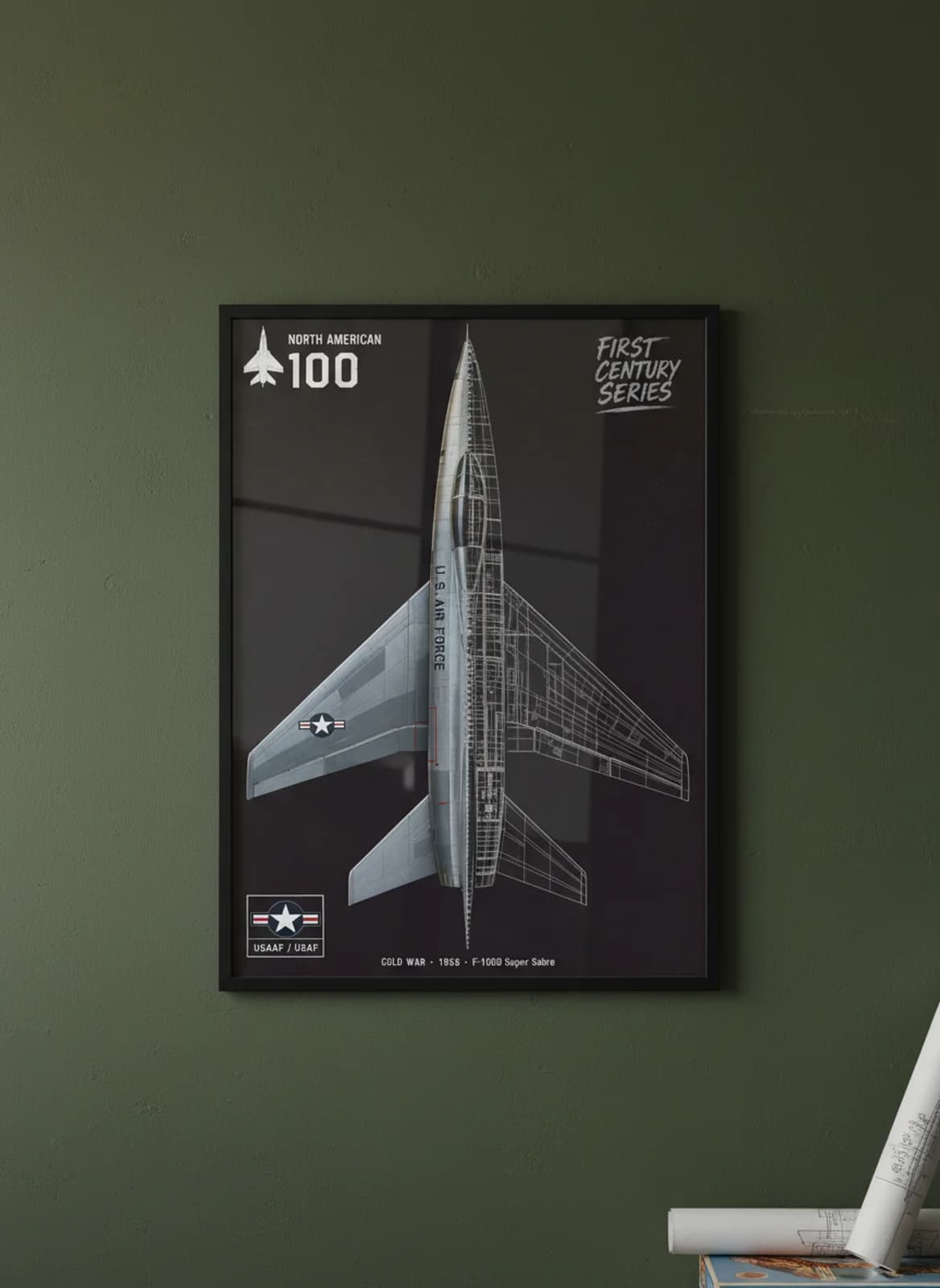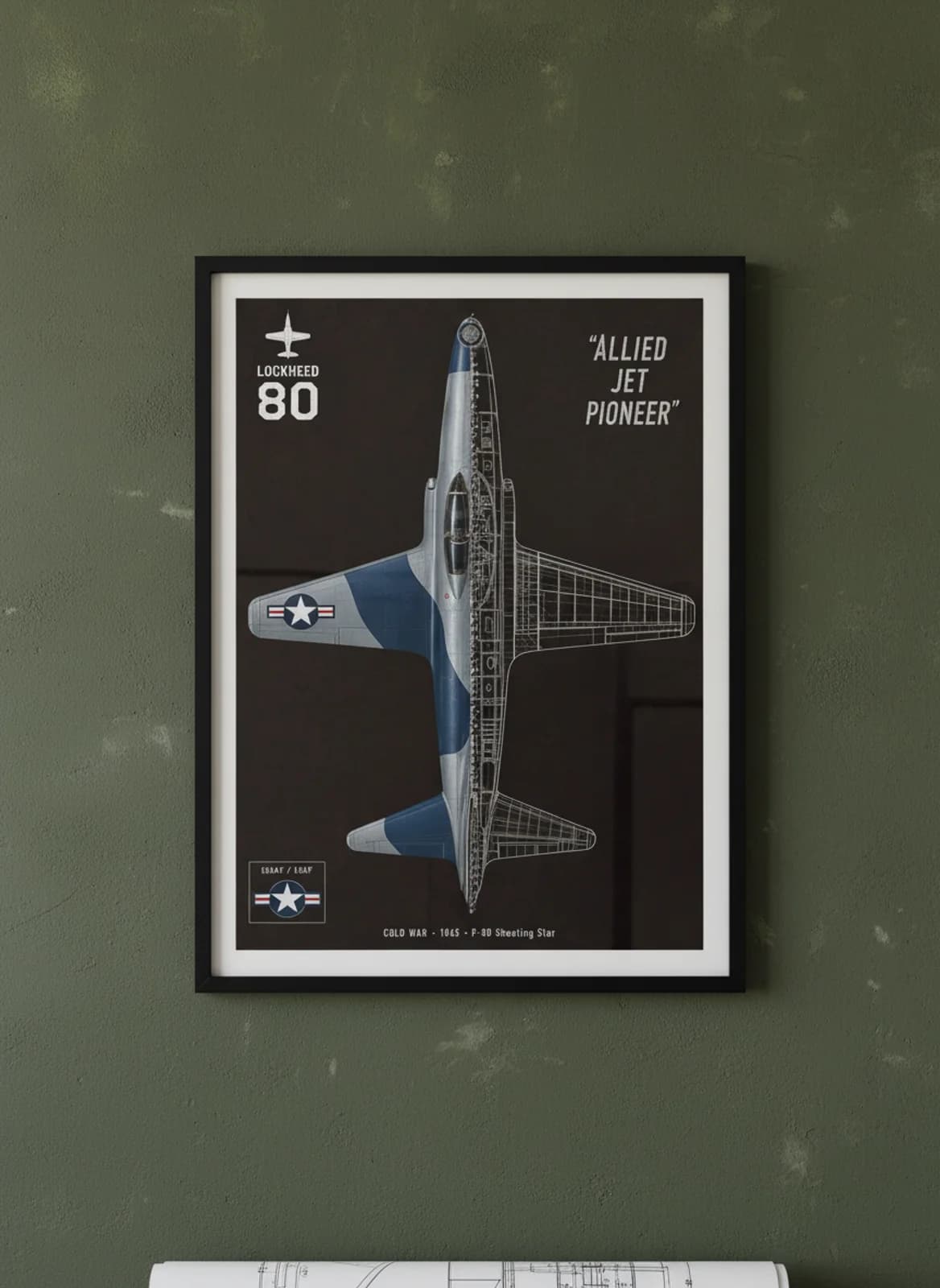
Natural Metal Silver — 4 museum-grade prints in this palette. The P-80 Shooting Star proved that American industry could design and mass-produce jet fighters without relying on captured German research alone — a Skunk Works achievement that accelerated every subsequent Lockheed program from the F-104 to the F-117. Though it arrived too late for World War II combat, the Shooting Star's Korea service as the F-80C and its T-33 trainer derivative trained a generation of jet pilots on both sides of the Iron Curtain. The Spitfire Mk IX, P-51D Mustang, and F-86 Sabre represent three eras of Western fighter aviation — British piston defence, American long-range escort, and the first generation of swept-wing jet superiority in Korea. The poster's Sortie Legend framing treats each airframe as a milestone rather than a squadron-specific documentation sheet, which is why the copy stays at operator and year level while the illustrations carry the recognisable roundels, nose art, and tail markings visible in each panel. The F-100 Super Sabre bridged the Korean War Sabre era and the Vietnam War Century Series fleet — a single-seat fighter whose afterburning J57 made Mach 1 routine for Tactical Air Command pilots who had watched F-86s flirt with the sound barrier only a few years earlier. Thunderbirds silver schemes and NATO deployments made the Super Sabre silhouette as recognizable in Europe as the F-86 had been over Korea.