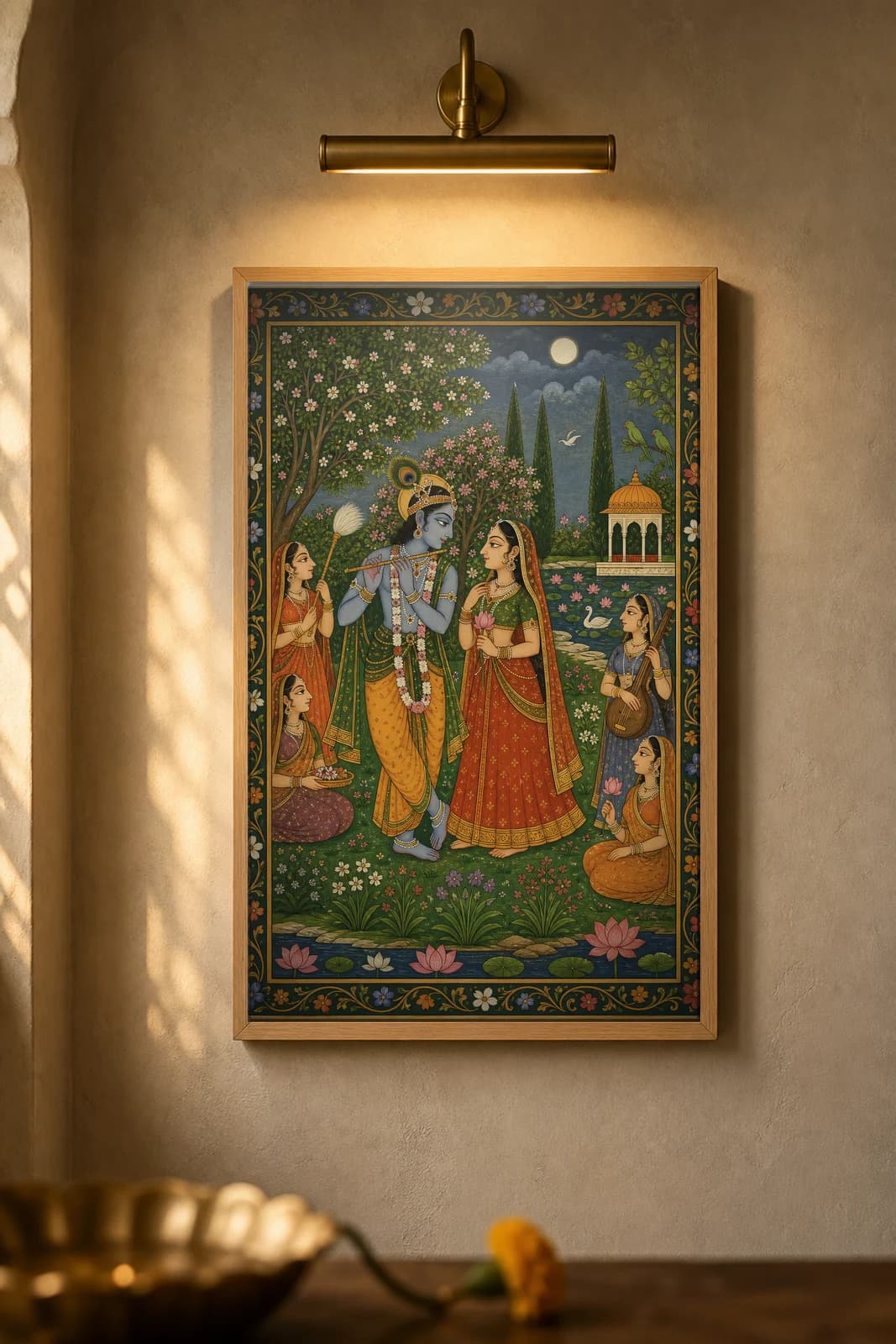
Lapis Night Blue — 6 museum-grade prints in this palette. The Baramasa ('twelve months') pairs each month with a mood of love; Sharad, the clear autumn month, is associated with Sharad Purnima — the harvest full moon held to be the brightest and most auspicious of the year, also the night of Krishna's moonlit raas in Vaishnava lore. This treatment follows the Kishangarh school of mid-18th-century Rajasthan, which flourished under Raja Sawant Singh and his painter Nihal Chand and is known within the Rajput miniature umbrella for refined pastel grounds, lapis skies and idealized cool harmony. Marwar, the desert court of Jodhpur, is the Rajput school of intense saturated grounds and desert intensity. This contemporary fusion borrows its solo-performer grammar for the Kalbeliya dance of the Kalbeliya community — once snake-handlers — whose serpentine movements and black mirror-worked skirts were inscribed on UNESCO's Representative List of the Intangible Cultural Heritage of Humanity in 2010, danced to the been and the dholak. Krishna-lila — the love of Krishna and Radha — is the highest devotional and lyrical subject of Rajput and Pahari painting; the Kishangarh school, flourishing in mid-18th-century Rajasthan under Raja Sawant Singh and his painter Nihal Chand, is celebrated for drawing the divine lovers with its idealized profile of the arched eye and fish-curved brow, often in a moonlit bower (kunj). Kishangarh sits within the Rajput miniature umbrella alongside Mewar, Bundi, Marwar, Amber and the Pahari Kangra school, all painted in mineral pigments — lapis, malachite, hingul vermillion, orpiment — and ochre 'gold' on burnished wasli paper, in flat symbolic perspective.